Ancient Rome and the Modern Military
Legions, leadership, military words, and ideas that still echo through modern armed forces.
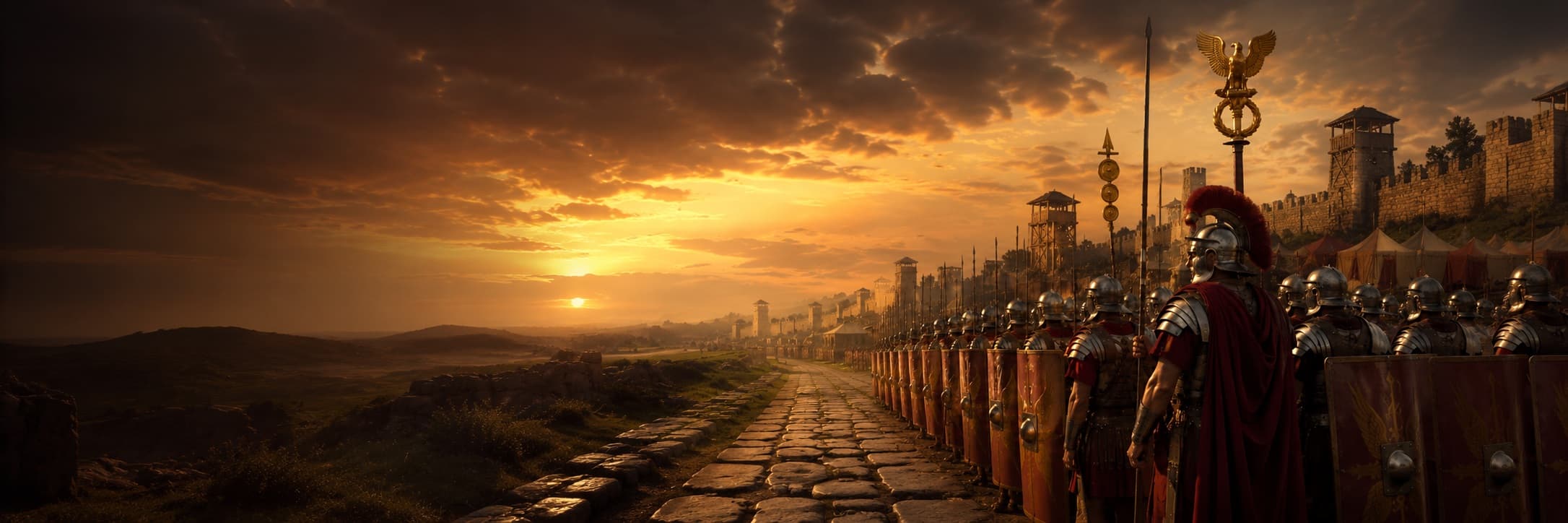
Ancient Rome did not create the modern U.S. military — but it helped shape the vocabulary, imagination, and organizational logic of Western military history. Words like legion, cohort, veteran, infantry, cavalry, triumph, and fort all carry traces of the Roman world. Rome’s system of professional discipline, unit identity, logistics infrastructure, and civic-military culture informed how European and later American military thinkers organized armies, trained soldiers, and justified military service as a civic duty. This section explores the Roman military machine, its lasting language, how it compares with the modern U.S. armed forces, and how both Rome and America navigated the shift from citizen-soldier to professional warrior.
Articles in This Section

Ancient Rome's Military Machine: How the Legion Worked
What was a Roman legion? Explore the structure of legions, cohorts, centuries, and centurions — and why Rome's military system lasted over five centuries.
Read article →

Roman Military Words Still Used Today
Veteran, infantry, cavalry, fort, cohort, triumph — 15 words with Roman military roots that still shape how we talk about war, leadership, and civic life.
Read article →

Ancient Rome vs. the Modern U.S. Military
Legions vs. six armed services. Consuls vs. civilian command. Siege engines vs. nuclear deterrence. A careful comparison across command, technology, strategy, and identity.
Read article →

From Citizen-Soldiers to Professional Forces
Rome evolved from a citizen militia to a professional army. America did the same — through the militia tradition, Civil War volunteers, WWII drafts, and today's all-volunteer force.
Read article →
Why Rome Matters to U.S. Military History
The founders of the American Republic were steeped in classical education and read Roman historians like Livy, Polybius, and Vegetius. George Washington was compared to Cincinnatus — the Roman citizen-soldier who left his farm to save Rome and then returned to it. The Senate, civic virtue, republican government, and the ideal of military service as a duty of citizenship all have deep roots in Roman political culture. When early American military leaders designed their institutions, they drew consciously from the Roman model of discipline, unit structure, and professional soldiering.
That Roman inheritance did not produce identical institutions — the U.S. military operates under constitutional civilian control, a professional volunteer force, and technological capabilities Rome could not have imagined. But the intellectual lineage is real, and understanding Rome helps illuminate the deeper history of military organization, leadership, and civic identity that underpins the modern American armed forces.
The Roman Military Legacy in Modern Language
Latin was the language of the Roman army, and military Latin saturates the English language. The word veteran comes directly from the Latin veteranus, meaning “old soldier.” Infantry derives from Latin roots for foot soldiers. Cavalry traces to the Latin caballus, horse. Fort and fortification come from fortis, meaning strong. Camp and campus share the Latin campus, field — which is also why university grounds are called campuses. Even the word military itself derives from the Latin militaris.
These linguistic traces are not mere curiosities. They remind us that Western military culture has a continuous thread running from the Roman legions to the modern barracks, from the Roman aquila(eagle standard) to the American eagle on every officer’s insignia. Our full glossary of Roman military words covers 15 terms with their ancient roots and modern military and civilian uses.
A Note on Historical Comparison
Comparisons between Rome and the modern United States are intellectually rewarding but must be made carefully. Rome was a slave society that expanded by conquest and lacked anything resembling constitutional civilian oversight of its military — especially in the imperial period. The modern U.S. military operates under strict civilian control as specified in the Constitution, governed by the Uniform Code of Military Justice, and subject to congressional appropriation and oversight. The parallels we draw are intellectual and organizational, not political equivalences. See our Rome vs. U.S. Military comparison for a careful side-by-side treatment that respects both the similarities and the profound differences.
