Overview
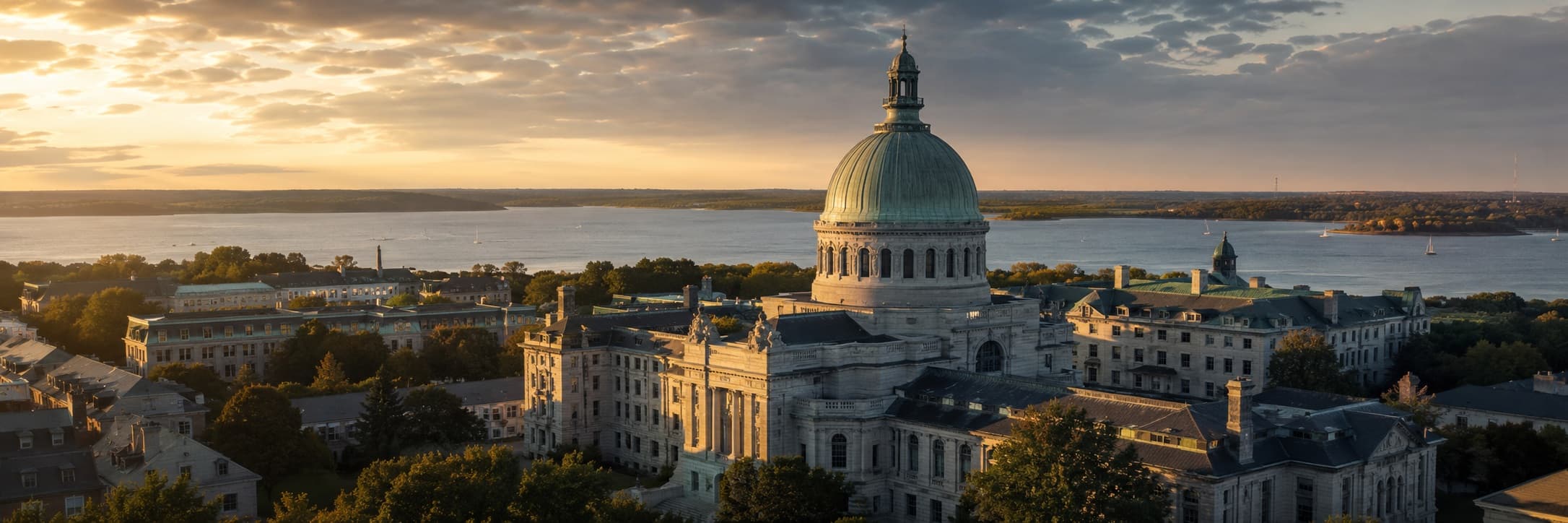
The United States Naval Academy in Annapolis, Maryland is the second-oldest federal service academy, founded in 1845 on the banks of the Severn River where it meets the Chesapeake Bay. Its mission is to develop midshipmen morally, mentally, and physically and to imbue them with the highest ideals of duty, honor, and loyalty — graduating officers who will serve the Navy and Marine Corps with distinction.
Each year approximately 1,200 midshipmen graduate and are commissioned as Ensigns in the Navy or Second Lieutenants in the Marine Corps. The Academy is a fully accredited four-year institution offering 26 majors, with a heavy emphasis on engineering and science. Like all federal service academies, attendance is fully funded — tuition, room, board, and medical care are covered, and midshipmen receive a monthly stipend.
Annapolis — "The Yard" — sits at the convergence of the Severn River and Chesapeake Bay, giving midshipmen unparalleled access to seamanship training aboard the Academy's fleet of sailing and powered vessels. The iconic Bancroft Hall — home to all 4,400 midshipmen — is one of the largest dormitories in the world. The historic chapel, with Admiral John Paul Jones' crypt beneath its main altar, is the spiritual center of the Academy.
USNA graduates have commanded every major naval campaign in American history. From the Naval Battle of Manila Bay to the Pacific campaigns of World War II, from Cold War submarine operations to the global war on terrorism, Annapolis has produced the admirals and generals who have led American sea power.
History
The United States Navy operated for half a century without a formal officer-education institution. Early naval officers learned their trade at sea — pragmatic but inconsistent. Secretary of the Navy George Bancroft, a Harvard-trained historian and future U.S. minister to Great Britain, decided to change that. On October 10, 1845, Bancroft quietly — and without Congressional approval — converted Fort Severn in Annapolis into a naval school with 50 midshipmen and 7 instructors. By avoiding a formal Congressional debate, he presented a fait accompli that Congress subsequently accepted.
The school was renamed the United States Naval Academy in 1850 and reorganized into a four-year program. The Civil War brought an early crisis: when Maryland teetered on the edge of secession in 1861, the Academy was temporarily relocated to Newport, Rhode Island to protect it and its midshipmen. It returned to Annapolis in 1865, expanded, and rebuilt.
The late 19th century was the era of Alfred Thayer Mahan — USNA Class of 1859 — whose book The Influence of Sea Power upon History (1890) revolutionized naval strategy worldwide and shaped the strategic thinking of Theodore Roosevelt, Kaiser Wilhelm II, and navies around the globe. The Spanish-American War of 1898 saw USNA graduate George Dewey destroy the Spanish Pacific Fleet at Manila Bay in a single morning, launching America as a Pacific power.
World War II defined the modern Naval Academy. Fleet Admiral Chester Nimitz (Class of 1905) commanded all Allied naval forces in the Pacific. By 1945, USNA graduates held commands at every level of naval warfare from destroyer captains to theater commanders. The Cold War brought nuclear submarine warfare, carrier battle groups, and the Academy's continued evolution.
In 1976, women were admitted to the Naval Academy along with the other federal service academies. Today, women make up approximately 30% of the Brigade of Midshipmen. In 1994, the Academy began admitting international midshipmen from allied nations, deepening its role in American alliance relationships.
Notable Graduates
Admiral of the Navy (highest rank in U.S. Naval history)
George Dewey is the only person in U.S. history to have held the rank of Admiral of the Navy, the highest naval rank ever conferred.
View Profile →Fleet Admiral; Commander in Chief, Pacific Fleet (WWII)
Chester Nimitz commanded all Allied air, land, and sea forces in the Pacific Ocean Area during World War II and oversaw the defeat of Imperial Japan.
View Profile →Captain, USN; U.S. Senator from Arizona (1987–2018)
John McCain was a Navy aviator who endured five and a half years as a prisoner of war in North Vietnam before a long career in the U.S. Senate.
View Profile →39th President of the United States
Jimmy Carter served as a submarine officer and nuclear engineer before entering politics, eventually becoming the 39th President of the United States.
View Profile →Commander, USN; NASA Astronaut
Kayla Barron is a Naval Academy graduate, submarine officer, and NASA astronaut who spent 177 days aboard the International Space Station as part of Expedition 66.
View Profile →Admissions
Admission to the Naval Academy is a competitive, multi-step process that evaluates academic achievement, physical fitness, leadership potential, and character. Approximately 1,200 candidates are admitted each year from a pool of more than 15,000 inquiries.
Academic Requirements The middle 50% of admitted midshipmen score 1240–1510 on the SAT (combined) or 28–35 on the ACT. The Academy emphasizes mathematics and science — most midshipmen arrive with strong foundations in calculus, chemistry, and physics. Most admitted candidates ranked in the top 20–40% of their high school class.
Physical Requirements All candidates must pass the Candidate Fitness Assessment (CFA): a basketball throw, pull-ups (or flexed-arm hang for women), shuttle run, sit-ups, push-ups, and a one-mile run. Competitive scores significantly strengthen an application. A DoD medical examination through the DoDMERB process is also required, including vision standards (waivable for some conditions).
Plebe Summer Admitted candidates report in late June for "Plebe Summer" — seven weeks of intensive military indoctrination before the academic year begins. Plebe Summer has been described as the most demanding military training program conducted at any American college.
Application Timeline
- Spring of junior year: Begin the online pre-candidate questionnaire
- Junior year fall/spring: Request nominations from congressional offices
- Summer/fall of senior year: Complete DoDMERB medical examination
- January of senior year: Submit complete application to the Academy
Athletics are valued — USNA fields 30 NCAA Division I teams — and recruited athletes who meet academic and nomination standards have a competitive advantage.
Nominations
Like West Point, a congressional nomination is required for most appointments to the Naval Academy. The nomination process exists to ensure geographic representation across the nation's naval officer corps.
Congressional Nominations Each U.S. Senator and Representative may have up to 5 midshipmen enrolled at USNA at any time. Vacancies open annually as midshipmen graduate. Senators and Representatives conduct competitive selection processes — typically involving interviews, essays, and review of academic and extracurricular records — and submit a ranked list of nominees to the Academy.
Presidential and Vice-Presidential Nominations The President may nominate up to 100 midshipmen per year from children of career military personnel (active, reserve, or retired). The Vice President holds similar authority. These nominations are administered through the White House Military Office.
Other Sources
- Children of Medal of Honor recipients receive automatic appointments with no nomination required
- Congressional Delegate nominations for Washington D.C. and U.S. territories
- NROTC scholarship pathways (not an appointment, but a separate commissioning route)
- Enlisted Navy and Marine Corps active-duty members may apply through the Naval Academy Preparatory School (NAPS) in Newport, Rhode Island — a one-year program that prepares enlisted candidates for the rigors of USNA
Navy/Marine Option Upon commissioning, eligible graduates may request Marine Corps service rather than Naval. A portion of each graduating class is commissioned into the Marine Corps, subject to quota availability and the graduate's class standing and preference.
Service Obligation
Graduates of the Naval Academy incur a five-year active duty service obligation as commissioned officers, followed by three years in the Individual Ready Reserve (IRR) — a total eight-year military service commitment.
Navy Commissioning Track Navy-commissioning graduates attend Officer Basic Courses for their selected community:
- Surface Warfare: Surface Warfare Officer School (SWOS) in Newport, Rhode Island, followed by assignment to a commissioned ship
- Submarine Warfare: Nuclear Power School in Goose Creek, South Carolina (6 months), then Submarine Officer Basic Course, then a submarine assignment
- Naval Aviation: Primary flight training at Naval Air Station Pensacola, Florida, followed by advanced training leading to designation as a Naval Aviator (wings of gold) or Naval Flight Officer
- Special Operations: BUD/S (Basic Underwater Demolition/SEAL training) in Coronado, California — the most physically demanding path, with historical attrition rates exceeding 70%
Marine Corps Track Graduates selecting Marine service attend The Basic School (TBS) at Marine Corps Base Quantico, Virginia — 26 weeks of officer infantry training all Marine officers complete regardless of specialty — followed by their Military Occupational Specialty (MOS) school.
Nuclear Obligation Officers who complete Nuclear Power School and submarine nuclear qualification incur additional service obligations due to the cost and intensity of nuclear training.
Aviation Obligation Naval Aviators who complete the full flight training pipeline incur an 8-year active duty obligation from the date of winging — significantly longer than the standard 5-year commitment.
Traditions & Culture
The Naval Academy's traditions are inseparable from maritime culture, the honor of the sea service, and a fierce identity as the forge of the Navy and Marine Corps officer corps.
Plebe Year The first year at the Academy is designed to be the most challenging — a deliberate immersion in military discipline, team building, and personal transformation. Plebes (fourth-class midshipmen) must meet exacting standards of military bearing, academic performance, and physical fitness. They are required to know hundreds of facts (called "rates") about naval history, current events, and Academy culture.
Herndon Monument Climb At the end of Plebe Year, all first-year midshipmen participate in one of the Academy's most beloved and grueling traditions: climbing the Herndon Monument — a 21-foot obelisk coated with lard — to replace the "dixie cup" (enlisted sailor's cap) at its peak with an officer's cover. The class works together as a team; the midshipman who places the cover is traditionally predicted to become the first admiral of the class.
Army-Navy Game Played annually since 1890, the Army-Navy football game is a national event. The entire Brigade of Midshipmen attends en masse, and the game generates weeks of spirit competitions, pranks (called "spirit spots"), and inter-service rivalry. It is one of the most tradition-rich sporting events in America.
Ring Dance During junior (Youngster) year — actually at the end of second-class (junior) year — midshipmen celebrate receiving their class rings in a formal ball known as the Ring Dance. The ceremony involves dipping the ring in water from the seven seas, a tradition connecting each class to the Academy's maritime mission.
John Paul Jones and Naval Heritage Father of the American Navy, John Paul Jones is interred in a marble sarcophagus beneath the Academy chapel — the spiritual and literal foundation of the institution. His famous words, "I have not yet begun to fight," are part of the cultural fabric every midshipman absorbs.
Commissioning Week The week of graduation — Commissioning Week — is among the most moving celebrations in American military life. It culminates in the graduation and commissioning ceremony, where newly minted officers are sworn in and midshipmen throw their covers (hats) into the air in the iconic photo that has defined Naval Academy graduations for generations.
FAQ
Is the Naval Academy free? Yes. All costs — tuition, room, board, uniforms, medical, and dental care — are covered by the federal government. Midshipmen receive a monthly stipend (approximately $1,100–$1,200/month) to cover personal expenses. In return, graduates commit to five years of active duty service.
What is the difference between a Navy commission and a Marine Corps commission? Both are full commissions as officers of the United States. Navy-commissioned graduates serve as Ensigns in the fleet — on ships, submarines, or in aviation — while Marine-commissioned graduates attend The Basic School and serve in the Marine Corps. A portion of each class selects the Marine option, subject to quota and class standing.
Can women attend the Naval Academy? Yes. Women have attended USNA since 1976 and make up approximately 30% of the Brigade of Midshipmen. Women serve in every warfare community including submarines (since 2010), carrier aviation, and special operations.
What majors are available? USNA offers 26 majors spanning engineering (aerospace, electrical, mechanical, ocean, systems), quantitative science (mathematics, chemistry, physics, oceanography, computer science), and humanities and social sciences (history, economics, political science, English). All midshipmen complete a core curriculum in engineering regardless of major.
Do I need to know how to swim? Yes. All midshipmen must pass a comprehensive swimming qualification. Naval service is inherently maritime, and basic water survival skills are non-negotiable. Students with limited swimming experience are strongly advised to develop competency before arrival for Plebe Summer.
Football and Academy Tradition
Football is one visible part of the wider athletic and institutional culture shared by America’s five federal service academies.
Explore service-academy football history and rivalries →Official Resources
