U.S. Marine Corps
The Marine Corps provides power projection from the sea, using the mobility of the Navy to deliver combined-arms task forces rapidly.
Overview
The United States Marine Corps (USMC) is one of the most elite and storied fighting forces in the world. Often called "the nation's 911 force," the Marine Corps is designed for rapid response — projecting combined-arms combat power from the sea to any crisis point in the world, typically within days.
With approximately 180,000 active-duty Marines, the Corps is the smallest of the four major services but arguably the most recognized. Marines are renowned for their discipline, warrior ethos, and fierce esprit de corps. The Eagle, Globe, and Anchor (EGA) insignia — representing service on land, at sea, and in the air — is one of the most recognized military symbols in the world.
The Marine Corps maintains its own air wing, ground combat element, and logistics capability, making it a self-contained combined-arms force. Marine Expeditionary Units (MEUs) — approximately 2,200 Marines with their own aircraft, landing craft, and combat equipment — are continuously deployed aboard Navy ships, ready to respond anywhere in the world within 72 hours.
The Corps' motto, Semper Fidelis ("Always Faithful"), reflects the fierce loyalty that defines the Marine identity — loyalty to the nation, the Corps, and to one another. Once a Marine, always a Marine.
History
The Marine Corps was founded on November 10, 1775, at Tun Tavern in Philadelphia — a fact every Marine knows by heart. Samuel Nicholas became the first Commandant, and the Continental Marines served as sharpshooters in naval vessel rigging and as raiding parties ashore.
The Marines earned their nickname "Leathernecks" from the leather collars worn to protect against sword cuts. The Marines' Hymn — "From the Halls of Montezuma to the Shores of Tripoli" — references two early campaign honors: the storming of Chapultepec Castle during the Mexican-American War (1847) and the assault on the Barbary pirate stronghold at Derna (1805).
World War I gave the Marines their enduring nickname. During the Battle of Belleau Wood (1918), German soldiers stunned by the ferocity of Marine attacks reportedly called them "Teufelshunde" — Devil Dogs. The name stuck.
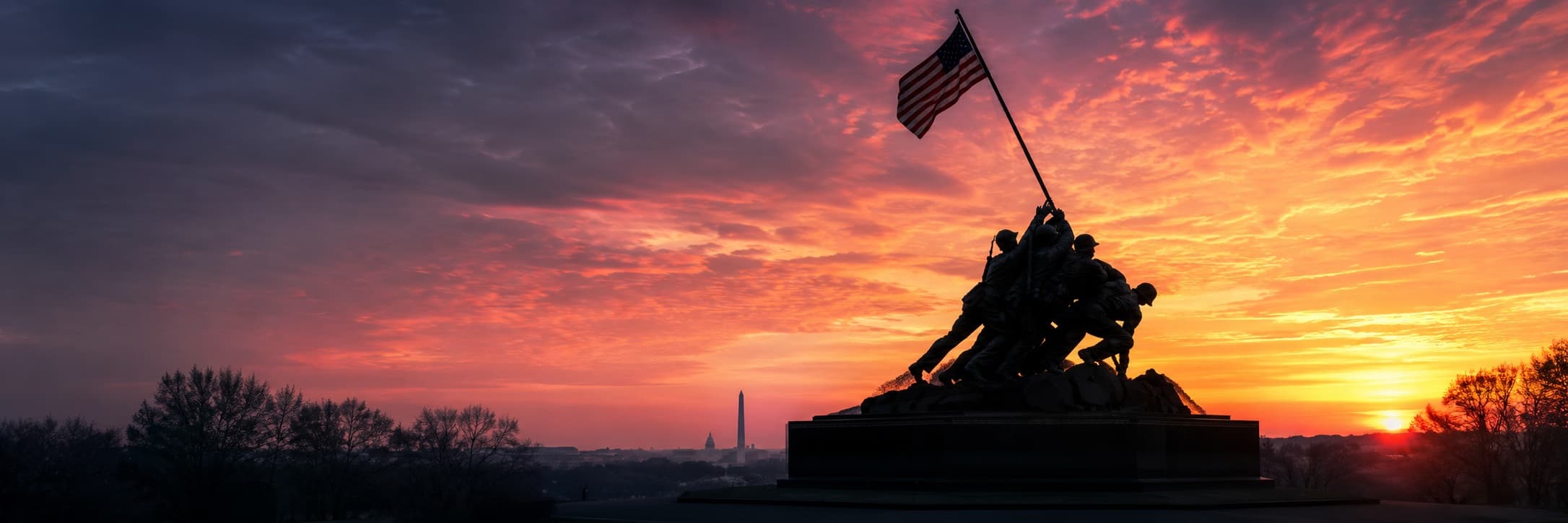
World War II defined the modern Corps through the brutal island-hopping campaign across the Pacific: Guadalcanal, Tarawa, Peleliu, Iwo Jima. The flag-raising on Mount Suribachi, immortalized in Joe Rosenthal's photograph and the Marine Corps War Memorial in Arlington, remains the most iconic image in American military history.
The Corps fought at the "Frozen Chosin" in Korea, through the jungles of Vietnam, and across the deserts of Kuwait, Iraq, and Afghanistan. Marines have participated in every major American military operation in the Corps' 250-year history.
Mission
The Marine Corps' mission is to provide forces in readiness — power projection and expeditionary forces as combined-arms task forces for contingency and combat operations at and from the sea.
In plain terms: Marines exist to go first. When a crisis erupts and the President needs a capable combined-arms force rapidly, it is the Marine Corps that answers. Forward-deployed MEUs can reach most coastal areas on Earth within 72 hours of an order.
The Corps is unique in maintaining its own ground, air, and logistics capabilities — it does not depend on other services to fight as a combined-arms force. Marine Air-Ground Task Forces (MAGTFs) integrate infantry, artillery, helicopters, fixed-wing aircraft, and logistics into a single seamlessly commanded unit that can operate independently from the moment it hits the beach.
Under Force Design 2030, the Marine Corps is reorganizing to focus on distributed maritime operations in contested littoral environments — particularly relevant to potential conflicts in the Pacific, where small, dispersed Marine units armed with anti-ship missiles and advanced ISR capabilities can control key island chains and sea lanes.
Major Commands
- Marine Forces Command (MARFORCOM) — Commands all Marine forces assigned to U.S. Joint Forces Command; provides Marines for Atlantic, European, and Central Command operations.
- Marine Forces Pacific (MARFORPAC) — Commands Marine forces in the Indo-Pacific; the largest Marine command, responsible for the Corps' most critical and demanding theater.
- Marine Forces Reserve (MARFORRES) — Commands all Reserve Marine forces; provides trained units ready for rapid mobilization to augment active-duty forces during crises.
- Marine Corps Combat Development Command (MCCDC) — Develops Marine Corps doctrine, organization, training, materiel, and future force concepts.
- Training and Education Command (TECOM) — Oversees all Marine Corps training from recruit training through senior leader professional military education.
- Marine Forces Special Operations Command (MARSOC) — Commands Marine Raiders, the Corps' special operations component within U.S. Special Operations Command, conducting direct action and foreign internal defense missions globally.
Traditions, Motto & Symbols
Motto: Semper Fidelis ("Always Faithful") This Latin motto defines the Marine ethos — unwavering loyalty to country, Corps, and fellow Marines. It is not merely a slogan; it is a lifelong commitment. The title "Marine" is never modified by the word "former." Once earned, it is permanent.
Official Song: The Marines' Hymn The oldest of the official U.S. service songs, The Marines' Hymn traces its lyrics to 1847 and its melody to a French comic opera. "From the Halls of Montezuma to the Shores of Tripoli" — these opening words reference the Corps' two earliest campaign honors and are committed to memory by every Marine.
Colors: Scarlet and Gold Scarlet represents the blood shed by Marines in defense of the nation. Gold represents the highest achievements and standards of Marine Corps service.
The Marine Corps Birthday Ball: Every November 10, Marines worldwide celebrate the Corps' birthday with a formal ball. The highlight is a traditional cake-cutting ceremony: the first slice goes to the oldest Marine present, who passes a piece to the youngest — symbolizing the transfer of experience and tradition across generations.
The Eagle, Globe, and Anchor (EGA): The moment a recruit receives the EGA at the end of Boot Camp is the defining transition — the moment they become a Marine. The eagle represents the nation, the globe represents worldwide service, and the anchor represents the naval tradition.
Career Paths
The Marine Corps offers a warrior-focused career path. All Marines — regardless of specialty — begin as riflemen, completing the same recruit training before branching into their Military Occupational Specialty (MOS).
Enlisted Marines complete 13 weeks of Recruit Training (Boot Camp) at Parris Island, SC or San Diego, CA — the longest basic training of any U.S. service — followed by the School of Infantry (SOI). Key MOS fields include Infantry (03 series), Aviation (72 series), Intelligence (02 series), Communications (06 series), Motor Transport (35 series), and Logistics (04 series).
Warrant Officers are technical experts in fields such as aviation, intelligence, logistics, and cyberspace operations — experienced Marines promoted for specialized mastery.
Commissioned Officers graduate from the Naval Academy, Marine Corps Officer Candidates School (OCS) at Quantico, or the Platoon Leaders Class (PLC) program. All officers — regardless of specialty — complete The Basic School (TBS) at Quantico, which emphasizes small-unit tactical leadership above all else.
Marine Raiders (MARSOC): Marine Raiders are special operations forces trained for direct action, special reconnaissance, and foreign internal defense. Selection is open to experienced infantry officers and staff NCOs.
Education Benefits: The Post-9/11 GI Bill, Tuition Assistance, and Marine Corps University's professional military education programs are available to all Marines.
FAQ
Is the Marine Corps part of the Navy Department? Yes. Administratively, the Marine Corps falls under the Department of the Navy alongside the U.S. Navy. However, it is a fully independent service branch with its own Commandant who sits on the Joint Chiefs of Staff and a distinct identity, culture, and mission.
What is the difference between a Marine and a soldier? "Soldier" refers specifically to Army personnel. Marines are never called soldiers — and correcting that mistake is a matter of pride. Each service branch has its own culture, training, mission, and traditions that set it apart.
How long is Marine Corps Boot Camp? Recruit training is 13 weeks — longer than any other U.S. service's basic training. It is considered the most physically and mentally demanding initial military training in the armed forces, with a strong emphasis on discipline, the warrior ethos, and unit cohesion.
What is Force Design 2030? Force Design 2030 is the Marine Corps' ongoing modernization effort under Commandant General David Berger, reorganizing the Corps to focus on distributed maritime operations. It reduced tank battalions and added capabilities for island-hopping, anti-ship missile operations, and littoral competition — primarily aimed at potential conflicts in the Pacific.
Can I choose my MOS when enlisting? Recruits can express preferences for MOS fields, and recruiters will work toward those goals, but final assignments depend on ASVAB scores, physical qualifications, and the needs of the Marine Corps. Combat arms MOSs such as Infantry (0311 Rifleman) are always in demand.
Official Resources
U.S. Marine Corps — marines.mil