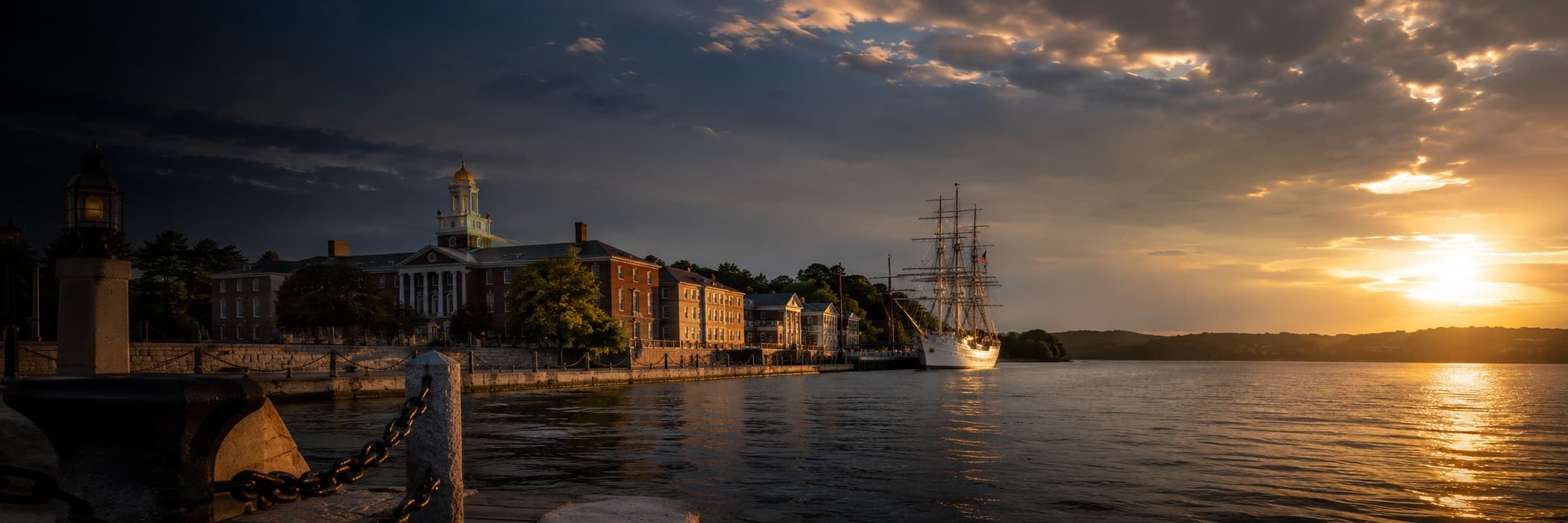
United States Merchant Marine Academy
Kings Point, New York · Est. 1943
Overview
The United States Merchant Marine Academy at Kings Point, New York is the most distinctive and least understood of the five federal service academies. Located on a 82-acre campus on the north shore of Long Island — on land once owned by auto magnate Walter Chrysler — Kings Point produces officers for the U.S. Merchant Marine and gives its graduates the unique option to commission in any branch of the U.S. Armed Forces.
Founded in 1943 at the height of World War II, when merchant mariners were dying at sea at rates comparable to any combat service, Kings Point has a founding mission unlike any other academy: to provide the commercially licensed officers who operate America's merchant fleet — the ships that carry the bulk of America's international trade, deliver military supplies in wartime, and sustain the global supply chains on which modern civilization depends.
Approximately 270 midshipmen graduate each year with both a Bachelor of Science degree and a United States Merchant Mariner License — qualifying them to serve as deck or engineering officers aboard commercial vessels of any size, anywhere in the world. This dual qualification — military academy graduate and federally licensed mariner — makes Kings Point graduates among the most uniquely prepared professionals produced by any college in the United States.
What makes Kings Point truly singular is its Sea Year: all midshipmen spend approximately 300 days at sea during their four years — actually aboard working commercial vessels, not training ships — sailing on vessels carrying cars, crude oil, liquefied natural gas, containers, and bulk cargo across every ocean. No other federal service academy puts its students to work in the actual industry they are training for before they graduate. Kings Point graduates don't just study maritime operations — they live them.
History
The Merchant Marine Academy's founding is inseparable from one of the bloodiest and least commemorated campaigns of World War II. From 1941 to 1945, German U-boats sank more than 1,600 Allied merchant vessels in the Atlantic alone, killing over 9,000 American merchant mariners — a casualty rate that exceeded those of every other American service except the Marine Corps. The men who crewed these unarmed supply ships, delivering the food, fuel, ammunition, and equipment that kept the Allies fighting, were the essential logistical backbone of the entire war effort.
When the United States entered the war in December 1941, the country lacked a sufficient pool of trained merchant officers to crew the fleet needed for a global war. The government had operated a small merchant marine training program, but nothing adequate for wartime demand. In February 1943, the Merchant Marine Academy was formally established at Kings Point, New York — the former Chrysler estate — to train officers at scale for the critical wartime shipping mission.
The Academy's first classes graduated quickly, filling billets on Liberty ships, tankers, and cargo vessels crossing U-boat-infested waters. Seventeen Kings Point midshipmen died at sea during World War II — making USMMA the only federal service academy with graduates killed in action while still enrolled as students. A memorial on the Academy grounds honors them.
Congress granted the Academy permanent status in the Merchant Marine Act of 1936 (amended in 1956), establishing it as a federal institution. The postwar decades saw the merchant marine evolve from government-operated wartime fleets to commercially operated vessels, and the Academy's mission evolved with it — training officers for both the commercial maritime industry and the Military Sealift Command, the Navy's logistics and transport force.
Today Kings Point graduates serve as captains and chief engineers on some of the largest vessels ever built, as officers in every branch of the armed forces, and as leaders in the maritime law, finance, logistics, and technology sectors that depend on international trade.
Notable Graduates
U.S. Senator for Arizona / NASA Astronaut Commander
Mark Kelly graduated from Kings Point in 1987, flew 39 combat missions in the Gulf War as a Navy F/A-18 pilot, commanded four Space Shuttle missions including Endeavour's final flight, and was elected U.S. Senator from Arizona in 2020 — one of the most varied and decorated careers in the history of service academy graduates.
View Profile →White House Chief of Staff (2001–2006)
Andrew Card graduated from Kings Point in 1971 and served as White House Chief of Staff under President George W. Bush from January 2001 through March 2006. On the morning of September 11, 2001, it was Card who leaned in to whisper to President Bush: 'A second plane hit the second tower. America is under attack.'
View Profile →Director of National Intelligence / CINC U.S. Pacific Command
Admiral Dennis C. Blair commanded the United States Pacific Command from 1999 to 2002 — the largest geographic combatant command in the U.S. military — before serving as the second Director of National Intelligence under President Barack Obama, overseeing all 17 agencies of the U.S. Intelligence Community.
View Profile →Admissions
Admission to Kings Point requires both a congressional nomination and a competitive academic record — similar to West Point, USNA, and USAFA. The Academy admits approximately 270 midshipmen per year from a competitive national applicant pool.
Academic Requirements Admitted midshipmen typically score 1200–1480 on the SAT (combined) or 26–33 on the ACT. The Academy's technical curriculum — marine transportation or marine engineering — requires strong foundations in mathematics and science. Most admitted candidates ranked in the top 30% of their high school class.
Physical Requirements All candidates must pass the Candidate Fitness Assessment (CFA) and a Department of Defense medical examination through DoDMERB. The USMMA physical exam includes a comprehensive vision evaluation — the commercial mariner licensing process has its own vision standards, and candidates should be aware of these requirements early.
Mariner Aptitude Kings Point evaluates candidates for aptitude for the unique demands of the maritime profession: the ability to work for extended periods away from home, the self-discipline to thrive at sea, and the mechanical or navigational aptitude suited to marine transportation or marine engineering.
Sea Year Reality Applicants should understand that Sea Year — approximately 300 days aboard working commercial vessels — is mandatory. Midshipmen live and work aboard cargo ships, tankers, and container vessels as part of their training. This is a profound, transformative experience, but it requires comfort with extended periods away from family, living in close quarters, and working in industrial maritime environments.
Application Timeline The process mirrors the other congressional academies: begin the application in the spring of junior year, pursue congressional nominations in fall of senior year, and complete the medical examination and fitness assessment before the final application deadline in late winter of senior year.
Nominations
Kings Point requires a congressional nomination, similar to West Point, the Naval Academy, and the Air Force Academy. The nomination process exists to ensure geographic representation in the maritime officer corps.
Congressional Nominations Each U.S. Senator and Representative may have up to 5 midshipmen enrolled at USMMA at any time. Senators and Representatives conduct competitive selection processes — typically including interviews, essays, and academic review — and submit ranked nominees to the Academy.
Presidential and Vice-Presidential Nominations The President may nominate up to 12 midshipmen per year from children of career military personnel. The Vice President holds similar authority. Nominations from U.S. territories and Washington D.C. are also available through Congressional Delegates.
A Key Difference from Other Academies At West Point, USNA, and USAFA, a nomination is a prerequisite for admission. At Kings Point, the process is broadly similar — but because the Academy is smaller (~270 per class vs. ~1,200 at West Point), the competition for nominations and appointments is intense. Candidates in districts where competition for nomination slots is high may face particularly stiff competition.
Children of Merchant Mariners Kings Point gives special consideration to children of licensed U.S. Merchant Mariners in some nomination categories, reflecting the Academy's roots in the commercial maritime industry.
Service Obligation
Kings Point's service obligation is unique among the federal service academies: graduates must serve for six years in the maritime industry or the U.S. Armed Forces — or a combination of both — following graduation.
The Merchant Marine License Every Kings Point graduate receives a U.S. Coast Guard-issued Merchant Mariner's License as either a Third Mate (deck track) or Third Assistant Engineer (engineering track) — the entry-level officer rank for commercial vessels of unlimited tonnage on oceans worldwide. This license is a federally issued professional credential, renewable throughout a mariner's career, and recognized by most maritime nations.
The Service Commitment Options
Option 1 — Maritime Industry Service: Graduate serves as an officer aboard U.S.-flag commercial vessels, gaining sealift experience in support of national defense readiness. The minimum is 5 years of sea service (or shore-side maritime industry employment with a reserve commitment).
Option 2 — Military Commission: Graduate commissions as an officer in any branch of the U.S. Armed Forces — Army, Navy, Marine Corps, Air Force, Space Force, or Coast Guard — and serves the standard 5-year active duty obligation for that service. Kings Point is the only federal service academy whose graduates may commission into any of the six branches.
Option 3 — Combination: Graduates may split their commitment between sea service aboard commercial vessels and a military reserve component.
Military Sealift Command (MSC) Many Kings Point graduates serve as officers with the Navy's Military Sealift Command — the civilian-mariner-crewed fleet that delivers fuel, ammunition, food, and equipment to naval forces worldwide. MSC officers hold a unique hybrid identity: federally employed civilians with military training operating government vessels.
Strategic Value The merchant marine is formally designated a "fourth arm of national defense." In wartime, Kings Point graduates command the vessels that supply military operations — a mission as critical as any combat role and far less recognized.
Traditions & Culture
Kings Point's traditions are as distinctive as its mission — blending the military structure of the service academies with the working culture of the commercial maritime industry.
Sea Year The defining experience of a Kings Point education is Sea Year — the two semesters (approximately 300 days total, split between second and third year) that midshipmen spend working as watch-standing officers aboard actual commercial vessels. Midshipmen sail on container ships, crude oil tankers, LNG carriers, bulk carriers, and car carriers for shipping companies including Crowley, Maersk, American President Lines, and others.
Sea Year is unlike anything at any other college. A midshipman may spend months sailing from Houston to Rotterdam to Singapore and back, standing bridge watches with professional mariners, handling cargo operations, maintaining engineering systems, and navigating in all conditions. They return to campus as seasoned mariners before they have earned their degree.
Indoctrination Week ("Indoc") Incoming midshipmen — called "Plebes" or "Mids" — report in early July for Indoctrination Week, the Academy's version of basic training. Unlike the multi-week programs at other academies, Indoc is compressed — but it begins the transition from civilian to midshipman with physical training, military bearing instruction, and the traditions of the Academy.
The Kings Point Ring The Academy's class ring is a distinctive symbol worn by all graduates. Its design incorporates the twin lighthouses that flank the Academy's waterfront, the anchor of the merchant marine, and class-specific insignia.
Regimental Formal Inspections Kings Point maintains a full military regimental structure, with weekly dress inspections, drill formations, and a formal system of rank and discipline that mirrors the naval tradition from which the Merchant Marine draws its officer culture.
War Memorial and the Defenders of Freedom On the waterfront at Kings Point stands the American Merchant Mariners' Memorial — a somber tribute to the thousands of merchant mariners who died during World War II. Every graduating class passes this memorial, connecting them to the sacrifice that gave the Academy its founding purpose.
FAQ
Is Kings Point a military academy? Yes. The United States Merchant Marine Academy is one of the five federal service academies funded by the federal government and subject to congressional oversight. Midshipmen wear uniforms, follow military discipline, and graduate with the option to commission as officers in any branch of the U.S. Armed Forces. They are eligible for all veterans' benefits if they serve in a qualifying military capacity.
Is Kings Point fully funded like the other service academies? Yes — with one important distinction. Tuition, room, and board are covered by the federal government. However, midshipmen are responsible for some fees related to Sea Year (travel to and from vessel assignments) and personal expenses. Midshipmen receive a monthly stipend during their time at the Academy.
What is Sea Year? Sea Year is the period — approximately 300 days total, spread across the second and third years — when midshipmen serve as working junior officers aboard commercial vessels worldwide. It is the most unique element of a Kings Point education: no other college in the United States requires its students to work in their chosen industry for 10 months before graduating. Students earn actual watch-standing time logged in the maritime system toward their federal mariner's license.
Can I choose which military branch to commission into? Yes. Kings Point is the only federal service academy whose graduates may request commissioning in any of the six military branches — Army, Navy, Marine Corps, Air Force, Space Force, or Coast Guard — subject to that branch's needs and the graduate's qualifications. This flexibility is one of Kings Point's most significant advantages over the branch-specific academies.
What careers do Kings Point graduates pursue? Many graduates continue in the maritime industry as commercial officers and eventually captains or chief engineers. Others commission into the military. A significant number move into maritime law, logistics, international trade, energy (particularly LNG and offshore oil), finance, and senior management in shipping and supply chain companies. The Kings Point network — while smaller than the other academies — is extraordinarily tight-knit within the maritime and defense logistics industries.
Football and Academy Tradition
Football is one visible part of the wider athletic and institutional culture shared by America’s five federal service academies.
Explore service-academy football history and rivalries →Official Resources
