United States Air Force Academy
Colorado Springs, Colorado · Est. 1954
Overview
The United States Air Force Academy sits at 7,200 feet above sea level in the shadow of the Rocky Mountains north of Colorado Springs, Colorado — a campus whose dramatic setting matches the ambition of its mission: to develop officers of character who inspire great airpower. Established by Congress in 1954 and graduating its first class in 1959, USAFA is the newest of the three congressional service academies and the only one dedicated to air and space power.
Approximately 1,100 cadets graduate each year and are commissioned as Second Lieutenants in the U.S. Air Force or U.S. Space Force. The Academy is a fully accredited four-year institution offering 32 academic majors — the most of any federal service academy — with particular strength in engineering, computer science, aeronautical studies, and systems engineering. Like all federal service academies, attendance is fully funded, with cadets receiving tuition, room, board, medical care, and a monthly stipend.
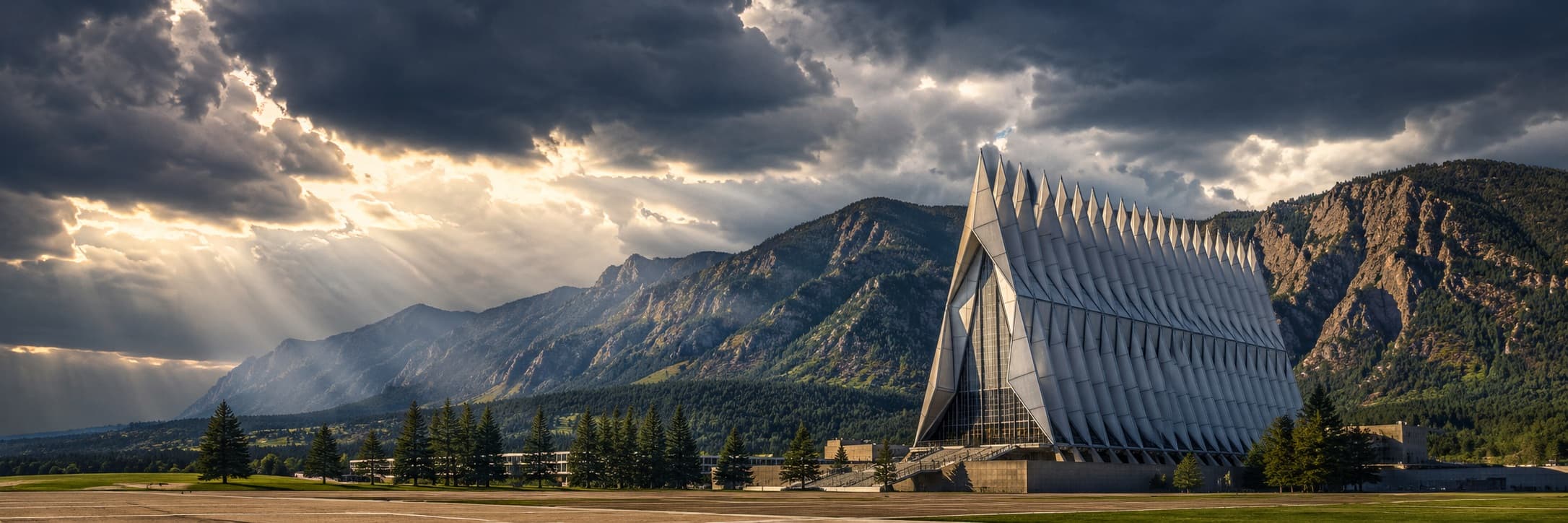
The Academy's iconic campus, designed by Skidmore, Owings & Merrill and completed in 1962, is a masterpiece of mid-century modernist architecture. The Cadet Chapel — its 17 spires rising like fighter jet tails against the Rocky Mountain skyline — is one of the most photographed buildings in Colorado and a National Historic Landmark. The Terrazzo (the central courtyard and plaza) connects the academic, military, and athletic facilities in a layout that is simultaneously functional and architecturally striking.
USAFA graduates have served as astronauts, combat pilots, acquisition officers, cyber warriors, and senior defense officials. The Academy's commitment to developing technically proficient, character-driven leaders for the most technologically demanding of the military services makes it one of the most competitive and rewarding undergraduate institutions in the United States.
History
The Air Force Academy was born from the recognition that the newest military service — independent only since 1947 — needed its own institution to forge the airmen who would lead it. In 1948, just one year after the Air Force became an independent branch, the first board to study a permanent Air Force academy was convened. Congress formally authorized the Academy in the Air Force Organization Act of 1954.
The first class of 306 cadets enrolled in July 1955 at a temporary site at Lowry Air Force Base in Denver. Site selection for the permanent campus sparked intense political competition among states — ultimately, a remote mesa north of Colorado Springs was chosen for its dramatic terrain, favorable weather for flying, and proximity to existing Air Force installations. The permanent campus, designed by architects Skidmore, Owings & Merrill with landscape design by Dan Kiley, opened in 1958. The Cadet Chapel — begun in 1959 and completed in 1963 — became the symbol of the Academy and was designated a National Historic Landmark in 2004.
The Class of 1959 became the first to graduate from the permanent campus and receive commissions in the Air Force. Throughout the 1960s, USAFA graduates entered the cockpits of Vietnam-era aircraft and the control rooms of the growing nuclear deterrent force. Academy graduates flew F-100s and F-105s over North Vietnam and commanded squadrons during the most intense air campaign since World War II.
In 1976, Congress authorized women to attend the federal service academies. The Air Force Academy's first female graduates completed their studies in the Class of 1980. Today women represent approximately 25% of the Cadet Wing.
The post-Cold War era and the emergence of space and cyber as warfighting domains prompted the Academy to evolve its curriculum substantially. The creation of the U.S. Space Force in 2019 gave USAFA a second commissioning mission — today a portion of each graduating class is commissioned into the Space Force, and the Academy is developing curriculum specifically designed to produce the Space Force's future leadership.
Notable Graduates
Captain, USAF (Medal of Honor, posthumous)
Captain Lance P. Sijan was the first Air Force Academy graduate to receive the Medal of Honor, awarded posthumously for extraordinary acts of heroism — including 46 days of solo evasion while severely wounded — as a prisoner of war in Vietnam.
View Profile →Captain, US Airways; Former USAF Fighter Pilot
On January 15, 2009, Captain Chesley "Sully" Sullenberger successfully ditched US Airways Flight 1549 on the Hudson River after both engines failed, saving all 155 people aboard in what became known as the Miracle on the Hudson.
View Profile →Lieutenant General, USAF (Ret.); NASA Astronaut
Susan Helms was a member of the first class of women to graduate from the Air Force Academy, flew five space shuttle missions, and holds the record for one of history's longest spacewalks — 8 hours and 56 minutes aboard the International Space Station.
View Profile →Admissions
The Air Force Academy is among the most selective undergraduate institutions in the United States, admitting approximately 1,100 cadets per year from a competitive applicant pool of more than 10,000.
Academic Requirements Admitted cadets typically score 1200–1500 on the SAT (combined) or 27–34 on the ACT. USAFA places particular emphasis on mathematics and science — calculus and chemistry are part of every cadet's first-year curriculum regardless of major. Most admitted candidates ranked in the top 25% of their high school class and took rigorous AP or honors courses, especially in math and science.
Physical Requirements All candidates must complete the Candidate Fitness Assessment (CFA) — a standardized test of upper body strength, core fitness, and aerobic capacity — and pass a DoD medical examination through DoDMERB. Vision requirements for pilot training are more stringent than the general admission standard, though corrected vision and laser surgery (PRK/LASIK) are generally accepted.
Pilot Candidates Cadets who aspire to become pilots should declare their intent early and pursue any available flight training prior to application (Civil Air Patrol cadet programs, introductory flight instruction, etc.). Pilot slots are competitive at the branch selection stage — not guaranteed at admission — but a demonstrated passion for aviation strengthens an application.
Extracurricular Leadership USAFA strongly values demonstrated leadership. Student government, athletics (particularly varsity sports), Civil Air Patrol, JROTC, Eagle Scout, and community service roles all contribute to a competitive profile.
Application Timeline Applications open in the spring of junior year. Candidates should simultaneously pursue congressional nominations, which have their own deadlines (typically fall of senior year). The Academy's application portal (admissions.usafa.edu) is the central hub for the process.
Nominations
A congressional nomination is required for most appointments to the Air Force Academy, following the same model as West Point and the Naval Academy.
Congressional Nominations Each U.S. Senator and Representative may have up to 5 cadets enrolled at USAFA at any time. As cadets graduate each year, new vacancies open. Congressional offices run their own selection processes — interviews, essays, recommendations, and academic review — and submit ranked lists of nominees to the Academy.
Presidential and Vice-Presidential Nominations The President may nominate children of career military personnel (active, reserve, or retired) — up to 100 per year. The Vice President holds similar nominating authority.
Other Nomination Sources
- Children of Medal of Honor recipients receive automatic appointments
- Congressional Delegate nominations for D.C. and U.S. territories
- Air Force ROTC scholarships (separate commissioning path, not an Academy appointment)
- Enlisted Air Force and Space Force members may apply through the USAFA Preparatory School (Prep School) — a one-year program at USAFA that prepares enlisted candidates for the academic and military demands of cadet life
Space Force Track A growing number of USAFA graduates now commission directly into the U.S. Space Force. Cadets interested in the Space Force track should declare their interest and pursue relevant coursework (astronautical engineering, space operations, cyber science) during their cadet career.
Service Obligation
USAFA graduates are commissioned as Second Lieutenants in the U.S. Air Force or U.S. Space Force and incur a five-year active duty service obligation, with three additional years in the Individual Ready Reserve (IRR).
Air Force Commissioning Tracks
- Pilot: Graduates selected for Undergraduate Pilot Training (UPT) at bases including Columbus, Laughlin, Sheppard, or Vance AFBs complete a year of intensive flight training. Upon earning wings, they incur an 8-year active duty commitment from the date of pilot designation. Pilots fly F-22s, F-35s, B-2 bombers, C-17s, KC-46 tankers, and dozens of other aircraft.
- Combat Systems Officer (CSO): The former "navigator" role — officers who operate weapons systems, sensors, and electronic warfare equipment aboard aircraft
- Air Battle Manager (ABM): Officers who direct and control airspace, manage air assets, and orchestrate air operations from airborne command platforms
- Space Operations: Officers assigned to manage satellites, missile warning systems, and space surveillance — particularly relevant for those pursuing Space Force commissioning
- Acquisitions and Engineering: Officers who develop, test, and procure Air Force and Space Force weapons systems
- Cyberspace Operations: Officers who defend Air Force networks and conduct offensive cyber operations
Space Force Track Cadets commissioning into the Space Force attend Space Force-specific training and are assigned to Space Operations Command (SpOC), Space Systems Command (SSC), or Space Training and Readiness Command (STARCOM).
Pilot Obligation The 8-year active duty obligation for pilots is among the most significant commitments in any service. It reflects the enormous investment the Air Force makes in flight training — often exceeding $8–12 million per pilot.
Traditions & Culture
The Air Force Academy blends the traditions of the older military academies with its own modern, aviation-focused identity and the dramatic backdrop of the Colorado Rockies.
Doolie Year Incoming cadets — called "Doolies" (from the Greek doulos, meaning servant) — report in late June for Basic Cadet Training (BCT), six weeks of military indoctrination that strip away civilian habits and begin building the discipline, teamwork, and military bearing expected of Air Force officers. BCT includes march-outs into the surrounding mountains, field training, and physical and mental challenges designed to forge cohesion among the incoming class.
Recognition At the end of Doolie year, upperclassmen "recognize" fourth-class cadets — formally acknowledging them as full members of the Cadet Wing after surviving their plebe year. Recognition Day is one of the most emotional days in the cadet calendar.
The Falcon Football Rivalries USAFA fields 27 NCAA Division I varsity teams. Football is the centerpiece, with annual rivalry games against Army (The Commander-in-Chief's Trophy, along with Navy, is the most coveted trophy in service academy football) and Navy, as well as Mountain West Conference opponents. The Commander-in-Chief's Trophy — awarded to the service academy team that defeats both other academies in a given year — rotates among Army, Navy, and Air Force.
Thunderbird Graduation Flyover USAFA's graduation ceremony is concluded with a flyover by the U.S. Air Force Thunderbirds — the Air Force's elite flight demonstration team. The sight and sound of F-16s in tight formation above the Terrazzo as new officers throw their hats in the air is one of the most iconic moments in American military ceremony.
The Honor Code "We will not lie, steal, or cheat, nor tolerate among us anyone who does." The Honor Code, enforced by the Cadet Honor Committee, is the moral foundation of Academy life. The non-toleration clause demands moral courage, not merely personal integrity.
The Cadet Chapel The Academy's soaring modernist chapel — with 17 aluminum spires pointing skyward — is the spiritual and architectural heart of the institution. It houses Protestant, Catholic, Jewish, Buddhist, and other worship spaces within the same structure and draws more than half a million visitors annually.
FAQ
Can I go to the Air Force Academy if I want to be in the Space Force? Yes. Since the creation of the U.S. Space Force in 2019, USAFA commissions a portion of each class directly into the Space Force. Cadets interested in the Space Force track should study astronautical engineering, space operations, or cyber science and express their preference during the branch selection process in their final year.
What does it cost to attend? Nothing. Tuition, room, board, uniforms, and medical care are all covered. Cadets receive a monthly stipend of approximately $1,100–$1,200 to cover personal expenses. The investment you make is your time and commitment — five years of active duty after graduation.
I want to be a pilot. Does attending USAFA guarantee pilot training? No. Pilot training slots are competitive — not every USAFA graduate who wants to fly will be selected. Academic performance, physical qualifications (especially vision), Pilot Candidate Selection Method (PCSM) scores, and class ranking all factor into pilot selection. That said, USAFA graduates are well-positioned for pilot training compared to other commissioning sources.
What are the vision requirements? General admission vision requirements are correctable to 20/20. Pilot training has more specific requirements for uncorrected and corrected vision, and many conditions are waivable. Laser eye surgery (PRK or LASIK) is generally approved for pilot candidates, though there are waiting periods before and after surgery.
How does USAFA compare to Ivy League schools academically? USAFA is consistently ranked among the top engineering and STEM schools in the nation by publications including U.S. News & World Report. Its 32 majors, small class sizes, and dedicated faculty make it a rigorous academic environment. The primary difference from civilian elite universities is the mandatory military training, physical requirements, and service commitment that accompany the education.
Football and Academy Tradition
Football is one visible part of the wider athletic and institutional culture shared by America’s five federal service academies.
Explore service-academy football history and rivalries →Official Resources
