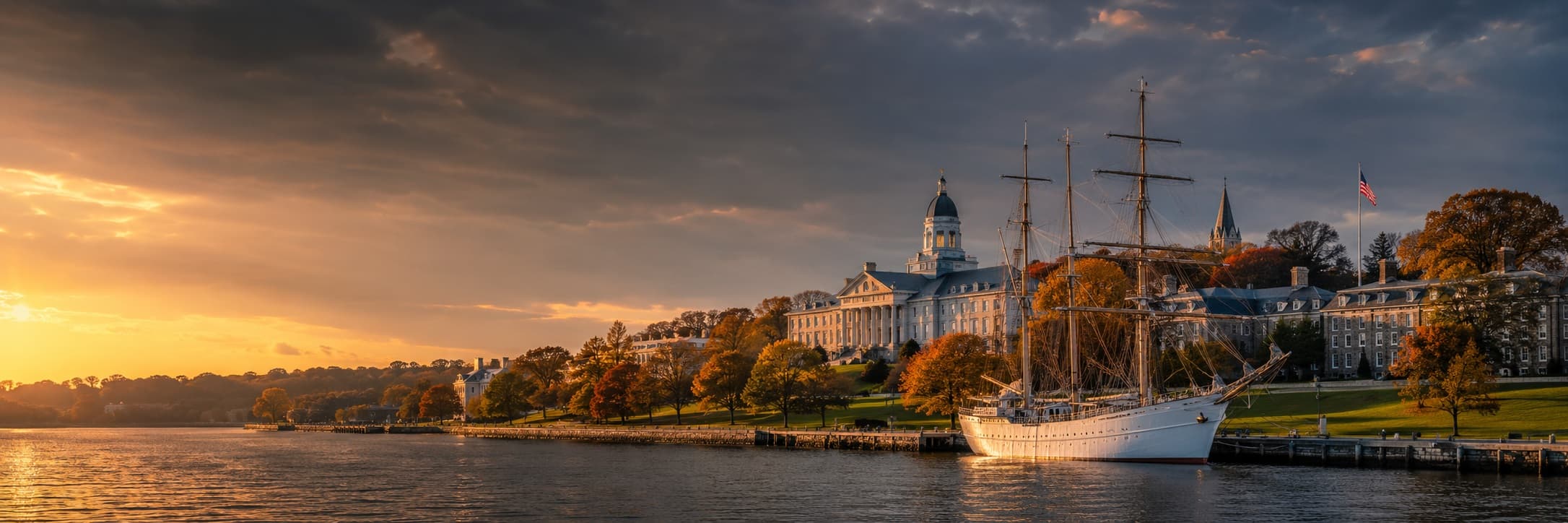
United States Coast Guard Academy
New London, Connecticut · Est. 1876
Overview
The United States Coast Guard Academy in New London, Connecticut stands apart from the other federal service academies in one fundamental way: it does not require a congressional nomination. Every cadet earns their place at USCGA purely on academic merit, leadership record, and physical fitness — making it the most democratically accessible of the five federal service academies and one of the most selective per-capita institutions in the United States.
Founded in 1876 as the Revenue Cutter Service School of Instruction, the Academy produces officers for the nation's oldest continuous seagoing service — a service that is simultaneously a military branch, a federal law enforcement agency, a search-and-rescue organization, and an environmental protection body. Each year approximately 250 cadets graduate and are commissioned as Ensigns in the U.S. Coast Guard.
The Academy's campus sits on the west bank of the Thames River — where it flows through New London toward Long Island Sound — giving cadets direct access to the maritime training that defines the Coast Guard experience. The Academy maintains its own fleet of training vessels, including the 295-foot barque Eagle, a three-masted sailing ship captured from Germany after World War II and now the Academy's principal offshore training platform.
With approximately 1,000 cadets in total — far smaller than the other academies — USCGA offers an intimate educational environment with exceptional faculty access, rigorous academic programs, and an officer corps that is close-knit by the nature of the Coast Guard's smaller scale. Every Ensign who graduates from New London will likely know, work alongside, or command others from their Academy cohort throughout their career.
History
The Coast Guard Academy traces its origins to 1876, when the Revenue Cutter Service — the Coast Guard's predecessor, founded by Alexander Hamilton in 1790 — established the School of Instruction aboard the schooner Dobbin in New Bedford, Massachusetts. The school trained officers for the cutters that enforced customs laws, suppressed smuggling, and rescued sailors in distress along America's coasts.
In 1900, the school was moved to the revenue cutter Chase and renamed the Revenue Cutter School of Instruction. As the service grew and its mission expanded, the need for a permanent shore-based campus became clear. After several temporary homes, the Academy found its permanent location in New London, Connecticut in 1932, on a campus overlooking the Thames River.
The 1915 merger of the Revenue Cutter Service and the U.S. Life-Saving Service to form the modern Coast Guard elevated the Academy's role. The Life-Saving Service's tradition — "You have to go out; you don't have to come back" — became part of the Academy's culture, reflected in the emphasis on search-and-rescue training and the rescue swimmer program.
The Academy gained significant stature during World War II, when Coast Guard officers commanded landing craft at Normandy and operated throughout the Atlantic and Pacific theaters. The acquisition of the German sail training barque Horst Wessel (renamed Eagle) after the war gave the Academy a living symbol of its seafaring heritage. Eagle remains one of only two active tall ships in U.S. government service and sails annually with cadets aboard.
In 1975, Congress authorized women to attend USCGA — one year before the other service academies. The Class of 1980 produced the first female Academy graduates. Today approximately 35–40% of the Corps of Cadets are women, one of the highest percentages of any federal service academy.
Notable Graduates
27th Commandant of the U.S. Coast Guard
Admiral Linda L. Fagan shattered the highest glass ceiling in U.S. military history when she became the 27th Commandant of the Coast Guard in 2022 — the first woman ever to serve as a service chief in the history of the United States Armed Forces.
View Profile →U.S. Secretary of the Treasury / Chairman of the Federal Reserve
G. William Miller is the only person in American history to have served as both Chairman of the Federal Reserve and U.S. Secretary of the Treasury. A Coast Guard Academy graduate, he served in World War II before leading Textron to become a major industrial conglomerate and then entering public service under President Jimmy Carter.
View Profile →NASA Astronaut / Captain, U.S. Coast Guard
Captain Bruce E. Melnick was the first member of the United States Coast Guard ever selected as a NASA astronaut. He flew two Space Shuttle missions — STS-41 aboard Discovery and the maiden voyage of Endeavour, STS-49 — logging over 480 hours in space before retiring from both the Coast Guard and NASA in 1992.
View Profile →Admissions
The Coast Guard Academy admits approximately 250 cadets per year through a merit-based process — no congressional nomination required. This makes the application process simultaneously simpler (no political nomination to secure) and more purely competitive (every applicant is evaluated on the same academic and personal standard).
Academic Requirements Admitted cadets typically score 1200–1480 on the SAT (combined) or 26–33 on the ACT. USCGA has a strong engineering curriculum — all cadets complete a rigorous core in mathematics, science, and engineering regardless of major. Most admitted candidates ranked in the top 25% of their high school class.
Physical Requirements All candidates complete the Candidate Fitness Assessment (CFA), identical to the other service academies, and a DoD medical examination through DoDMERB. The Coast Guard's active-duty mission in open-water search and rescue places particular emphasis on swimming — all cadets must demonstrate strong swimming ability.
Leadership and Character Because USCGA is merit-only, the evaluation of leadership record, extracurricular activities, and character references carries additional weight. Community service, varsity athletics, student government, Civil Air Patrol, and JROTC participation all strengthen applications.
Application Timeline The process begins in the spring of junior year via the Academy's online application portal. There is no congressional nomination track — the Academy makes all admissions decisions directly. Candidates apply directly to the Academy with transcripts, test scores, teacher recommendations, and the CFA results.
The Preparatory School A select number of competitive candidates who need additional academic preparation are offered positions at the Academy's Preparatory Program at the Coast Guard Training Center Cape May, New Jersey — a one-year program that prepares candidates to excel academically and militarily at USCGA.
No Nomination Required
The Coast Guard Academy is unique among the five federal service academies: no congressional nomination is required. This is the single most important distinguishing feature of the USCGA admissions process.
Why No Nomination? The Academy's merit-only admissions policy reflects the Coast Guard's history as a smaller, highly selective service that draws officers from across the nation based purely on capability and character — not political connections or geographic quotas.
What This Means for Applicants
- Any qualified U.S. citizen between 17 and 22 years old can apply directly to USCGA without contacting their congressional representatives
- Applicants are evaluated entirely on academic achievement, physical fitness, leadership record, and character
- The process is managed entirely by the Academy's admissions office
Compared to Other Academies At West Point, USNA, USAFA, and Kings Point, most candidates must secure a congressional nomination before the Academy can make an appointment offer. This adds a second competitive process, with its own deadlines, interviews, and essays. At USCGA, there is only one competition — and merit alone determines the outcome.
Opportunity for All The no-nomination policy makes USCGA particularly attractive to high-achieving students who may not have political connections or who live in highly competitive congressional districts where nomination slots are exceptionally difficult to obtain. A student in a rural area or underserved community with strong academics, leadership, and character has an equal shot at USCGA.
Service Obligation
USCGA graduates are commissioned as Ensigns (O-1) in the U.S. Coast Guard and incur a five-year active duty service obligation, followed by three years in the Individual Ready Reserve (IRR).
First Assignment: Officer of the Deck Most new Ensigns report to a Coast Guard cutter as a junior officer, working toward qualification as Officer of the Deck (OOD) — the officer responsible for the safe navigation and operation of the vessel during their watch. This hands-on sea duty is the foundation of a Coast Guard officer's career.
Operational Specialties After initial sea duty, officers may pursue specialization in:
- Aviation: Coast Guard aviators fly the MH-60 Jayhawk helicopter and MH-65 Dolphin for search-and-rescue, law enforcement, and counter-drug operations, as well as the HC-130 Hercules for long-range maritime patrol. Flight training is conducted at Naval Air Station Pensacola, Florida.
- Law Enforcement: Maritime law enforcement is a core Coast Guard mission — officers conduct boardings, drug interdiction, fisheries enforcement, and port security operations
- Marine Safety and Investigation: Officers inspect commercial vessels, investigate maritime accidents, and certify mariners
- Engineering and Response: Environmental response, naval architecture, and civil engineering career tracks
Rescue Swimmer Officers While rescue swimmers are primarily an enlisted specialty (AST), officers can serve as aviation commanders overseeing rescue operations. Some officers pursue the Aviation Survival Technician course as an additional qualification.
Uniqueness of Coast Guard Service Unlike the other services, Coast Guard officers regularly exercise federal law enforcement authority — making arrests, issuing citations, and conducting boardings of commercial and pleasure vessels. This law enforcement component gives Coast Guard service a dimension no other military branch provides.
Traditions & Culture
The Coast Guard Academy's traditions reflect the service's dual identity — military branch and maritime law enforcement agency — and the close-knit culture of a small institution where every cadet knows every other cadet.
"You Have to Go Out" Drawn from the Life-Saving Service tradition, this phrase — "You have to go out; you don't have to come back" — is the unofficial motto of Coast Guard rescue culture. It captures the unconditional commitment to save lives at sea regardless of conditions. Every cadet absorbs this ethos; every officer carries it throughout their career.
The Barque Eagle The USCGC Eagle — a 295-foot three-masted sailing barque — is the Academy's most tangible connection to maritime heritage. Built in Hamburg, Germany in 1936 as the Horst Wessel, she was transferred to the United States as war reparations in 1946 and has sailed with cadets ever since. Aboard Eagle, cadets learn celestial navigation, seamanship, and the fundamentals of watch-standing on one of the last traditional tall ships in government service. A summer cruise aboard Eagle is a rite of passage.
Swab Summer Entering cadets — called "Swabs" — report in late June for seven weeks of military indoctrination before the academic year. Swab Summer is physically and mentally demanding, designed to establish military discipline, build teamwork, and begin the transformation from civilian to officer candidate.
Chase Hall Named for Revenue Cutter Chase, Chase Hall is the Academy's main academic and administrative building — the center of cadet life. The building's traditions, including formal formations and ceremonial events, connect today's cadets to the service's 19th-century origins.
Corps of Cadets Recognition Like the other academies, USCGA has a formal recognition ceremony at the end of Swab Year — the moment when Swabs are accepted into the full Corps of Cadets by upperclassmen. It marks the end of the most demanding year of cadet life.
Regattas and Maritime Competition Given its riverside location and maritime mission, USCGA has a strong sailing and crew culture. The Academy fields competitive sailing, rowing, and other water sports teams, and inter-academy sailing competition is a significant part of the athletic calendar.
FAQ
Why doesn't the Coast Guard Academy require a congressional nomination? The Academy admits students purely on merit, without the geographic quota system used by the other academies. This reflects the Coast Guard's tradition of drawing officers based on capability and character. It makes USCGA the most meritocratic of the federal service academies and equally accessible to qualified candidates from any congressional district.
Is the Coast Guard Academy fully funded? Yes. Tuition, room, board, uniforms, and medical care are all covered. Cadets receive a monthly stipend (approximately $1,100–$1,200) to cover personal expenses. In exchange, graduates commit to five years of active duty service.
Is the Coast Guard a real military branch? Yes. The Coast Guard is one of the six branches of the U.S. Armed Forces. USCGA graduates are commissioned military officers with full veterans' benefits. In wartime, the Coast Guard operates under the Navy. In peacetime, it operates under the Department of Homeland Security. USCGA graduates serve in every theater of operations, from the Arctic to the Middle East.
What is the class size at USCGA? Approximately 250 cadets graduate per year, making the total Corps of Cadets roughly 1,000. This is far smaller than West Point (~1,200 per class), USNA (~1,200 per class), or USAFA (~1,100 per class). The smaller size means excellent faculty access, a tight-knit community, and personal mentorship from officers and faculty.
Can I fly for the Coast Guard after the Academy? Yes. Coast Guard Aviation is one of the most operationally diverse and demanding aviation career fields in any military service — flying the MH-60 Jayhawk helicopter on open-ocean search-and-rescue missions, interdicting drug traffickers in the Caribbean, and conducting Arctic patrols. Pilot training is conducted at NAS Pensacola alongside Navy and Marine Corps aviators.
Football and Academy Tradition
Football is one visible part of the wider athletic and institutional culture shared by America’s five federal service academies.
Explore service-academy football history and rivalries →Official Resources
