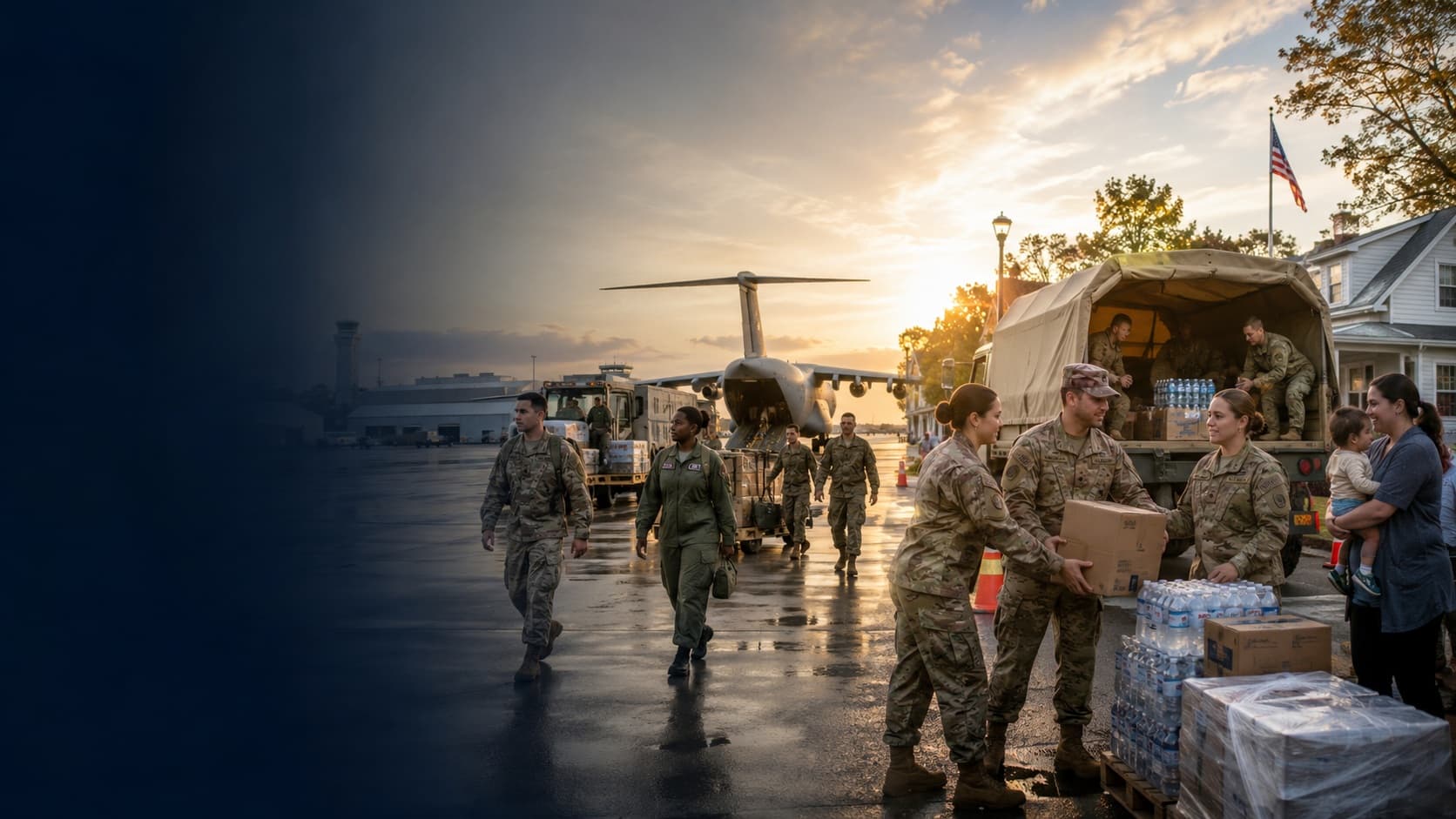
National Guard vs. Reserves
Two reserve components, one similar schedule, but fundamentally different legal authority, command structures, and missions.
The National Guard and the military Reserves are the most commonly confused components of the U.S. armed forces. Both involve part-time service. Both require one weekend per month and two weeks per year of training. But they operate under different legal authorities, answer to different commanders in peacetime, and serve fundamentally different missions.
The One Difference That Defines Everything
The National Guard has a state mission. The Reserves do not.
A governor can activate National Guard units at any time for any state emergency — without asking Congress, the President, or the Pentagon. No governor has that authority over a Reserve unit. That single distinction flows through every other difference between these two components.
The Guard’s state mission is rooted in the U.S. Constitution, which reserves certain militia powers to the states. This dual identity — simultaneously a state force and a federal reserve component — is what makes the National Guard constitutionally unique.
Reserve components (Army Reserve, Navy Reserve, Marine Forces Reserve, Air Force Reserve, Coast Guard Reserve, Space Force Reserve) exist purely under federal Title 10 authority. They are federal organizations with federal missions. States have no claim on them.
Side-by-Side Comparison
| Category | National Guard | Reserves |
|---|---|---|
| Legal authority | Dual: Title 10 (federal) AND state law. Can also operate under Title 32 hybrid status. | Title 10 only. Purely a federal reserve component with no state mission. |
| Who can activate them | Governor (for state missions) OR President (for federal mobilization). | President / Secretary of Defense only. Governors have no authority over Reserves. |
| State emergency response | Yes. Governors activate Guard units for hurricanes, wildfires, floods, civil unrest, and other state emergencies without federal authorization. | No. Reserve units cannot be deployed domestically by a governor. They require a federal order. |
| Overseas deployment | Yes, when federalized under Title 10. Has deployed extensively since 9/11. | Yes, under Title 10 orders. Same overseas deployment capability as active duty. |
| Typical schedule | One weekend per month (Battle Assembly) + two weeks annual training. Plus any state or federal activations. | One weekend per month (drill weekend) + two weeks annual training. Plus any federal mobilizations. |
| Where you live | Stay in your home community. No mandatory relocation required. | Stay in your home community. No mandatory relocation required. |
| Command structure | State Adjutant General → Governor (state). Combatant commander → SecDef → President (federal). | Service reserve command → combatant commander → SecDef → President. |
| Pay and benefits | Drill pay while in state status. Full active-duty pay and benefits when federally mobilized under Title 10. | Drill pay while inactive. Full active-duty pay and benefits when mobilized under Title 10. |
| GI Bill | Access to federal education benefits. State tuition assistance programs may also be available — these vary by state. | Access to federal Selected Reserve GI Bill (Chapter 1606) and other education benefits. |
| Healthcare (TRICARE) | TRICARE available during federal activations and for some qualifying service thresholds. TRICARE Reserve Select available for purchase. | TRICARE available during federal activations. TRICARE Reserve Select available for purchase. |
| Who they belong to | The Army National Guard belongs to both the U.S. Army and the individual state. The Air National Guard belongs to both the U.S. Air Force and the individual state. | Army Reserve belongs to the Army. Navy Reserve to the Navy. Marine Forces Reserve to the Marine Corps. Air Force Reserve to the Air Force. Coast Guard Reserve to the Coast Guard. |
| Which branches have them | Army and Air Force only. There is no Marine Corps, Navy, Space Force, or Coast Guard National Guard. | Army, Navy, Marine Corps, Air Force, Coast Guard, and Space Force each have separate reserve components. |
This table is for general educational purposes. Details vary by branch, state, and year. Always verify current specifics with an official recruiter.
Understanding Title 10 and Title 32
Federal Active Duty
Guards members mobilized under Title 10 are federalized — they serve under the President and Secretary of Defense, receive full active-duty pay and benefits, and can be deployed anywhere in the world. The governor has no command authority during Title 10 service.
Federal Mission, State Command
A hybrid status unique to the Guard. The federal government pays for the service and specifies the mission (such as counter-drug operations or overseas training), but the governor retains command authority. Used for many homeland defense and support missions. Not available to Reserve members.
State Mission, State Funding
Entirely funded by the state, used for state emergencies — flood response, wildfire suppression, civil support, and similar missions. The federal government has no involvement. Only available to Guard members. Pay is determined by state law and varies by state.
Education Benefits: Where the Guard Often Wins
Both Guard and Reserve members have access to the federal Selected Reserve GI Bill (Chapter 1606), which provides a monthly stipend for education. This benefit is the same for Guard and Reservists.
Where the Guard can have a significant advantage is through state tuition assistance programs. Many states offer their own education benefits exclusively for Guard members — some covering full in-state tuition at public colleges and universities. Reserve members do not receive state tuition assistance because Reserves are federal-only components.
For example, several states offer tuition waivers or substantial grants for Army and Air National Guard members attending state public colleges. These programs are in addition to federal GI Bill benefits — in some cases, a Guard member attending a state school can have most or all tuition costs covered.
Before choosing between the Guard and Reserves, research the specific education benefits offered by your state’s Guard program. The variation between states is significant, and education benefits can be a decisive factor for students and young adults considering service.
Common Misconceptions
Misconception:The Guard and Reserves are basically the same thing.
Reality:They share a similar part-time training schedule but are fundamentally different in legal authority and command structure. The Guard has a constitutional state mission; the Reserves do not. Governors can activate Guard units; they cannot activate Reserve units.
Misconception:Only the Guard responds to domestic emergencies.
Reality:In practice this is largely true, but Reserve members can be activated federally and then used in domestic support roles if ordered by the President. The difference is that governors can activate Guard without any federal involvement — they cannot do that with Reserves.
Misconception:Guard members don't deploy overseas.
Reality:Guard members have deployed extensively since 9/11. As of the mid-2020s, more than 650,000 Guard members have served in overseas operations since 2001. Guard units regularly deploy to combat zones, Europe, the Indo-Pacific, and other locations.
Misconception:The Reserves offer better federal benefits than the Guard.
Reality:The benefits are largely comparable during and after federal service. State-specific Guard benefits — including state tuition assistance programs that are often more generous than federal programs — can give the Guard a material advantage depending on the state.
Misconception:Choosing the Guard means you won't go to war.
Reality:Since 9/11, Guard mobilization rates for overseas service have been comparable to Reserve mobilization rates in some periods. Joining the Guard is not a way to avoid deployment.
Frequently Asked Questions
Which is better: National Guard or Reserves?
Neither is objectively better — they serve different needs. The Guard offers state tuition assistance programs, the ability to serve locally, and participation in both state emergency response and federal missions. The Reserves may offer a more predictable federal career track and are available in all six branches (not just Army and Air Force). The right choice depends on your goals, your state's Guard benefits, your desired branch, and your tolerance for potential deployments.
Can I transfer from the Reserves to the National Guard?
Yes, in most cases. Transfers between the Army Reserve and Army National Guard (or Air Force Reserve and Air National Guard) are possible, though they require coordination between units, approval from both the losing and gaining units, and may involve changes to your MOS or AFSC. Contact a recruiter from the gaining component for specifics.
Does the Guard or Reserves provide better education benefits?
It depends on your state. The federal Selected Reserve GI Bill (Chapter 1606) is available to both Guard and Reserve members. Many states offer their own tuition assistance programs for Guard members that can be substantially more generous — some covering full in-state tuition. Reserve members do not have access to state tuition programs. Research your specific state's Guard education benefits before deciding.
What happens to my civilian job when I'm deployed?
The Uniformed Services Employment and Reemployment Rights Act (USERRA) protects your civilian employment during military service — for both Guard and Reserve members. Your employer must hold a comparable job for you upon return. Additionally, the Servicemembers Civil Relief Act (SCRA) provides protections for financial obligations during deployment.

Emergency Preparedness Resource
Visit Disaster Kit Pro, a practical online resource designed to help households prepare for emergencies in a calm, manageable way.
