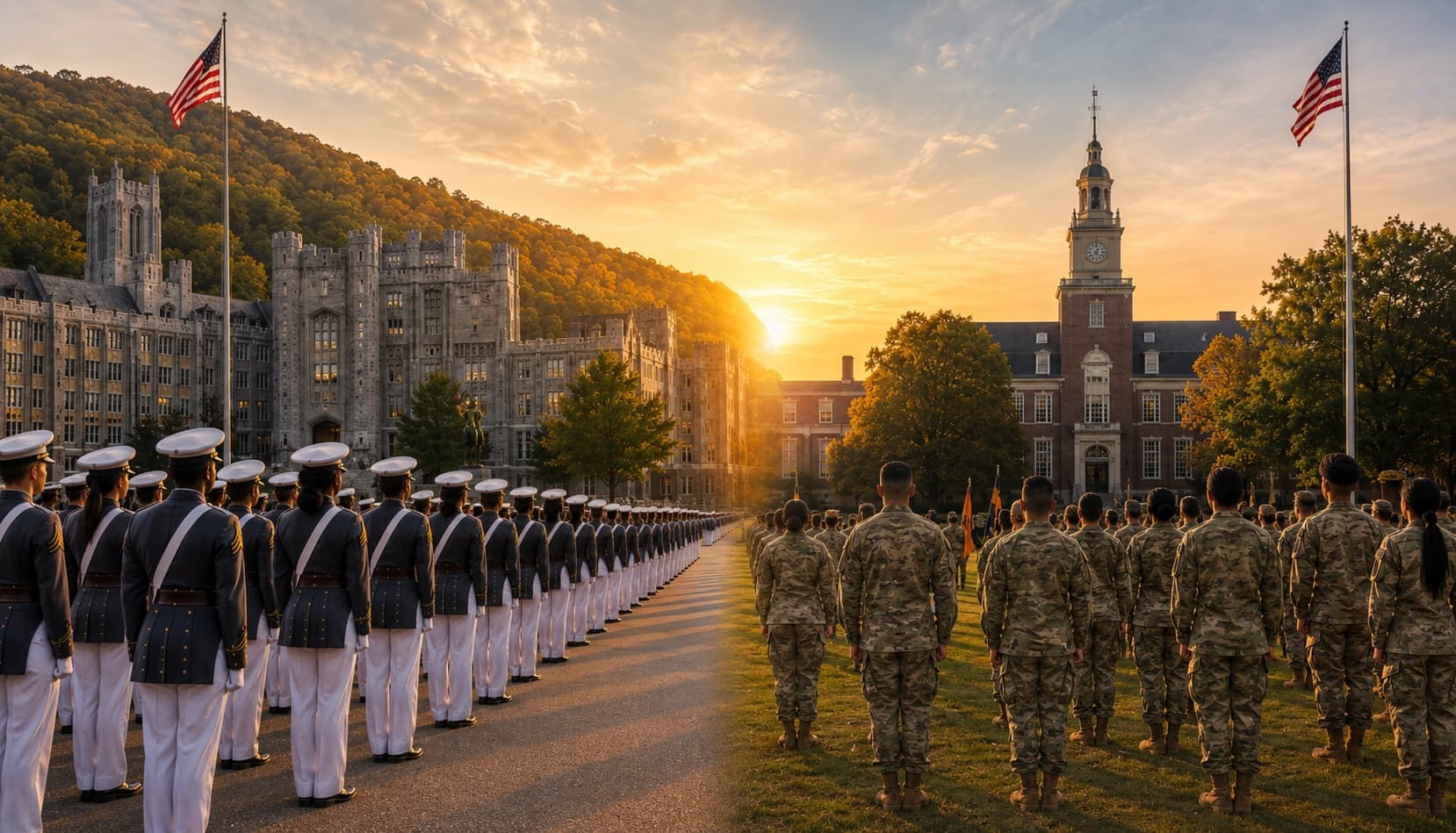
Service Academy vs. ROTC
Both paths can lead to a commission as a U.S. military officer. The college experience, structure, and lifestyle are very different.
Both federal service academies and ROTC programs can lead to commissioning as an officer in the U.S. military. But the college experience, application process, daily life, and long-term implications are substantially different. This guide helps students, parents, and counselors understand both paths clearly.
The Simple Explanation
A federal service academy is a military college run by the U.S. government. When you attend a service academy, you are a cadet or midshipman from day one. You wear a uniform every day, participate in formations and military duties, follow a structured schedule, and live in a highly disciplined institutional environment. In exchange, the federal government pays for your education — tuition, room, board, and a monthly stipend — and you commit to serving on active duty as an officer after graduation.
Reserve Officers’ Training Corps (ROTC) is a college-based officer commissioning program embedded at hundreds of civilian colleges and universities. ROTC students live and study like regular college students while taking military science classes and attending required training labs and exercises. Scholarships may be available depending on the branch and program. After successfully completing college and the ROTC program, students commission as officers. Unlike academy life, ROTC does not dominate your entire daily schedule.
The Service Academy Path in Detail
The environment at a federal service academy is distinctive and unlike any civilian college. From the first day of freshman training (called Beast Barracks at West Point, Plebe Summer at the Naval Academy, and equivalent programs at other academies), cadets and midshipmen are immersed in a military community. Academic courses, athletic programs, military duties, and leadership development are all integrated into a year-round schedule.
Academic majors at most academies are focused on engineering, science, mathematics, and related fields — though social science and humanities tracks are available. The academic workload is substantial and runs alongside mandatory military and physical training obligations.
Athletics and fitness are central to academy life. All cadets and midshipmen participate in athletic programs — either varsity intercollegiate sports or intramural and club athletics. Physical fitness testing is ongoing, not episodic.
Service obligation following graduation is typically five years of active-duty service. This is a legally binding commitment. Understand it fully before applying.
Nominations are required for most academies. See the nomination process for West Point, the Naval Academy, the Air Force Academy, and Kings Point. The Coast Guard Academy does not use the congressional nomination system and selects entirely on merit.
The ROTC Path in Detail
The civilian college experience is the defining feature of ROTC. ROTC students pick their own college (from hundreds with programs), choose from a broad range of majors, participate in campus life, and live in regular student housing. The military training — labs, physical training sessions, and leadership exercises — is scheduled but does not govern the entire week.
Branch-specific programs include Army ROTC (the largest), the Naval Reserve Officers Training Corps (which commissions into both the Navy and Marine Corps), and Air Force ROTC (which commissions into the Air Force and can produce Space Force officers). Each branch runs its own program with its own requirements and culture.
Scholarships — when available — can cover tuition and provide a monthly stipend in exchange for a service commitment after commissioning. Non-scholarship enrollment is also possible in many programs, meaning you can participate in ROTC and earn a commission without a scholarship (though you will pay regular tuition costs).
Summer training requirements vary by branch but typically include a multi-week leadership assessment course between junior and senior year. These camps are competitive and can affect commissioning outcomes.
Service obligation after commissioning through ROTC is generally comparable to academy commissioning, though specifics vary by branch, scholarship type, and program. Verify current obligations with the relevant branch.
Side-by-Side Comparison
| Topic | Service Academy | ROTC |
|---|---|---|
| College environment | Federal military academy — all students are cadets or midshipmen | Civilian college or university with regular student body |
| Daily structure | Highly structured military environment: formations, uniforms, military schedule | Mix of civilian college life and scheduled military training blocks |
| Admissions | Very competitive; evaluated by the academy and requires complete candidate file | College admission plus ROTC program enrollment; scholarship is a separate competition |
| Congressional nomination | Usually required for most academies (Coast Guard Academy is the exception) | Not required |
| Cost | Federally funded — tuition, room, and board paid; monthly stipend provided; service obligation required | Scholarship options available for some; non-scholarship enrollment also possible; regular tuition applies if no scholarship |
| Lifestyle | Full-time cadet/midshipman life — military duties alongside academics | Civilian student lifestyle with ROTC lab, exercises, and summer training |
| Commissioning | Upon meeting graduation requirements | Upon meeting graduation and ROTC program completion requirements |
| Best fit | Students who want an immersive, structured military college environment | Students who want a traditional college experience combined with officer preparation |
Which Is More Competitive?
Both can be highly competitive, but in different ways. Service academies accept a small number of applicants each year from a pool of thousands. The nomination requirement adds another layer of competition. ROTC scholarships are also competitive — not all applicants receive them. However, non-scholarship ROTC participation is available at many programs, making ROTC more accessible as an entry point. In short: a service academy appointment is among the most competitive college admissions outcomes in the country; ROTC scholarships are also selective but have more options and pathways.
Which Gives a More Normal College Experience?
ROTC, by a wide margin. ROTC students attend a civilian college, choose their own major, live in regular student housing, and manage their own schedule outside of their ROTC commitments. Academy students live in a structured military environment where their schedule, conduct, dress, and responsibilities are governed by military regulations throughout their four years. Neither is better — they reflect very different values and goals. Some students thrive in the academy environment precisely because of its structure; others need the freedom of a civilian campus.
Which Produces Better Officers?
Both produce excellent officers. The U.S. military is led by officers commissioned from all sources — academies, ROTC, OCS/OTS, and direct commission. The best officer is determined by character, performance, and leadership, not by which college they attended. Some of the most distinguished military leaders in history were ROTC graduates; some were academy graduates. Choose the path that fits your personality, goals, and circumstances — then commit fully.
Questions to Ask Yourself
Do I want a full-time military college environment from day one?
Do I want the freedom to choose my own college, major, and social life?
Am I ready for the structured, disciplined demands of academy life?
Do I want more flexibility in college experience while still becoming an officer?
Which branch do I want to commission into, and does it have ROTC programs at schools I want to attend?
Am I prepared to apply for nominations (for most academies) in addition to the academy application?
Do I have — or can I develop — the academic, athletic, and leadership record required for a competitive academy application?
What is my backup plan if I do not receive an academy appointment?
Other Paths to a Commission
Academies and ROTC are not the only ways to become an officer. Having a complete picture of all commissioning options helps you make a better decision — and ensures you have a solid backup plan.
OCS / OTS
Officer Candidate School (Army, Marines, Coast Guard) and Officer Training School (Air Force) are commissioning programs for college graduates who were not in ROTC or an academy.
Direct Commission
Professionals in medicine, law, chaplaincy, nursing, and cyber may commission directly into specialty officer roles without completing OCS, ROTC, or an academy.
Enlisted to Officer
Enlisted service members can pursue commissioning through ROTC, OCS, or other programs. Prior-enlisted officers are common and highly respected across all branches.
Reapplying to an Academy
Many applicants apply more than once. A stronger record on a second application is a legitimate and often successful strategy.
Academy Prep Schools
Some academies have affiliated preparatory programs that can strengthen a candidate’s academic and fitness record for the following application cycle.
Related Guides
Service Academies
Explore all five federal service academies — admissions, history, and service obligations.
Congressional Nomination Guide
How the nomination process works, who needs one, and how to build a strong application.
Joining the Military
Overview of all entry paths — enlisted, officer, ROTC, academies, and more.
Enlisted vs. Officer
Understand the two main career tracks in the military before choosing a path.
Compare Academies
Side-by-side comparison of all five federal service academies.
Still Deciding?
Ask Captain Liberty about service academies, ROTC, enlisted service, or any other question about how the U.S. military works.
Ask Captain Liberty