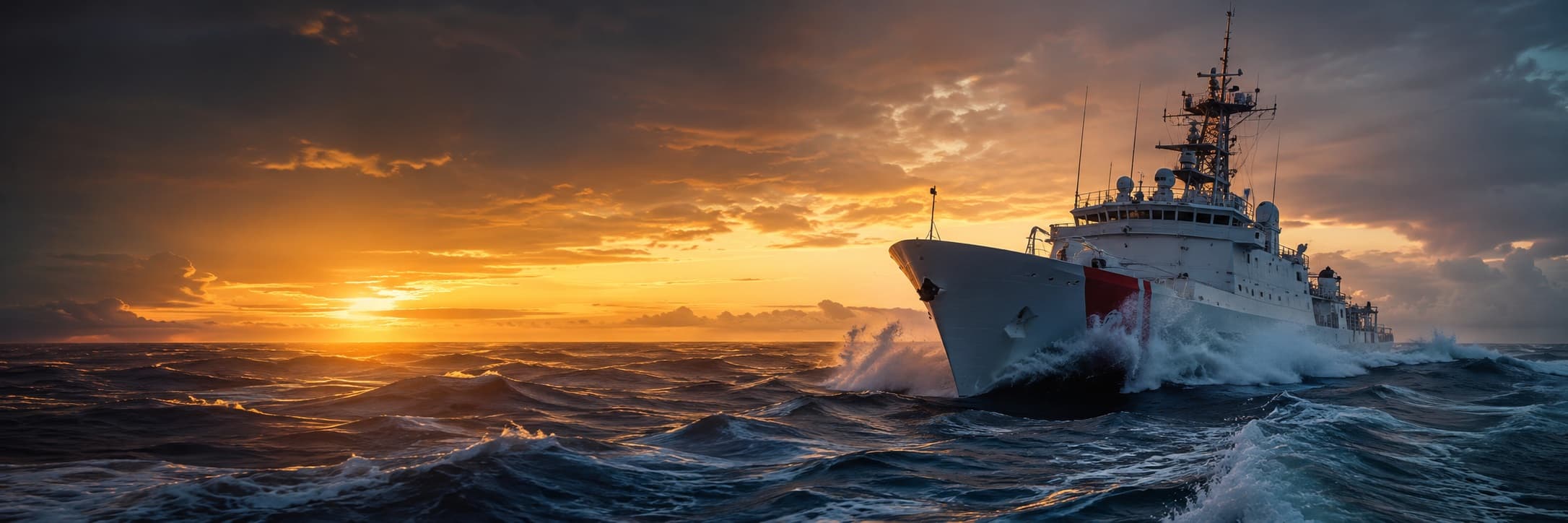
U.S. Coast Guard
The Coast Guard protects the public, environment, and U.S. economic and security interests in maritime regions, both domestically and internationally.
Overview
The United States Coast Guard (USCG) is a unique branch of the U.S. Armed Forces — the only military service that operates primarily within the United States during peacetime and the only service that functions simultaneously as a military branch, a federal law enforcement agency, a search-and-rescue organization, an environmental protection body, and a maritime safety authority.
In times of war or by presidential direction, the Coast Guard operates under the Department of the Navy. In peacetime, it falls under the Department of Homeland Security. This dual identity is what makes the Coast Guard unlike any other military branch in the world.
With approximately 40,000 active-duty members and a fleet of over 240 cutters, 1,800 boats, and 200 aircraft, the Coast Guard conducts approximately 16,000 search-and-rescue cases annually, saving roughly 4,000 lives per year. It is also the nation's primary maritime counter-narcotics force, seizing billions of dollars in illegal drugs each year.
Coast Guard members — proudly called "Coasties" — serve in every maritime environment from the Gulf of Mexico to the Arctic. The service's distinctive diagonal orange racing stripe on every vessel and aircraft is one of the most recognized symbols in American maritime law.
History
The United States Coast Guard traces its origins to August 4, 1790, when Secretary of the Treasury Alexander Hamilton established the Revenue Marine — later called the Revenue Cutter Service — to enforce tariff laws and prevent smuggling. This makes the Coast Guard the oldest continuous seagoing service of the United States, predating the reestablishment of the Navy in 1798.
In 1848, the U.S. Life-Saving Service was established, maintaining stations along the Atlantic and Great Lakes coasts where "surfmen" rowed small boats through violent surf to rescue sailors from wrecked ships. Their unofficial motto — "You have to go out; you don't have to come back" — defined a culture of selfless service that the Coast Guard carries to this day.
In 1915, the Revenue Cutter Service merged with the Life-Saving Service to form the modern United States Coast Guard. The service participated in every major American war — Coast Guardsmen crewed landing craft at Normandy during the D-Day invasion (1944), conducted coastal surveillance in Vietnam, and operated in both Persian Gulf conflicts.
In 2003, following the September 11 attacks, the Coast Guard was transferred from the Department of Transportation to the newly created Department of Homeland Security, reflecting its expanded role in maritime port security and counterterrorism. The Coast Guard's response to Hurricane Katrina (2005) — rescuing over 33,000 people — stands as one of the largest search-and-rescue operations in U.S. history.
Mission
The Coast Guard's mission encompasses eleven statutory functions divided between Homeland Security and Non-Homeland Security roles — a breadth of responsibility unmatched by any other military service.
Homeland Security Missions:
- Ports, Waterways, and Coastal Security (PWCS) — Protecting the nation's maritime borders and critical infrastructure from terrorist threats and hostile vessels
- Drug Interdiction — The nation's primary maritime counter-narcotics force, operating in the Caribbean and Eastern Pacific to intercept drug trafficking organizations
- Migrant Interdiction — Enforcing immigration laws at sea and conducting interdiction operations in the Florida Straits and Caribbean
- Defense Readiness — Providing trained and equipped forces to the Navy during wartime, including Port Security Units and Law Enforcement Detachments (LEDETs)
Non-Homeland Security Missions:
- Search and Rescue (SAR) — Responding to maritime distress calls 24 hours a day in all weather conditions
- Marine Safety — Inspecting commercial vessels and investigating maritime accidents
- Living Marine Resources — Enforcing fisheries laws and protecting marine ecosystems
- Marine Environmental Protection — Responding to oil spills and hazardous material incidents at sea
- Ice Operations — Maintaining navigation channels on the Great Lakes and conducting polar operations
Major Commands
- Atlantic Area (LANTAREA) — Commands all Coast Guard operations east of the Rocky Mountains, encompassing the Atlantic Ocean, Gulf of Mexico, Caribbean, and Great Lakes regions. Headquarters in Portsmouth, Virginia.
- Pacific Area (PACAREA) — Commands all Coast Guard operations west of the Rocky Mountains, including the Pacific Ocean, Bering Sea, and inland waterways of the western states. Headquarters in Alameda, California.
- Coast Guard Cyber Command — Defends Coast Guard networks, supports maritime critical infrastructure cybersecurity, and provides cyber capabilities to the broader Department of Homeland Security mission.
Traditions, Motto & Symbols
Motto: Semper Paratus ("Always Ready") Officially adopted in 1910, Semper Paratus defines the Coast Guard's operational philosophy — continuous readiness to respond to any maritime emergency, at any hour, in any sea state. It reflects the service's heritage of launching into violent storms to rescue those in peril on the sea.
Official Song: "Semper Paratus" Written in 1927 by Captain Francis Saltus Van Boskerck aboard USCGC Yamacraw, the song has been the Coast Guard's official march for nearly a century. Its chorus — "We're always ready for the call, we place our trust in Thee" — captures the service's ethos of duty, faith, and continuous readiness.
Colors: Blue, White, and Orange Coast Guard blue and white reflect the maritime heritage of the service. The distinctive diagonal orange-red racing stripe — designed in 1967 by industrial designer Commander Peter Knapp and applied to every cutter and aircraft — provides instant recognition during maritime emergencies and has become synonymous with the Coast Guard worldwide.
"You Have to Go Out" Heritage: Drawn from the Life-Saving Service tradition, this phrase embodies the Coast Guard rescue swimmer and boat crew culture — the obligation to launch regardless of conditions when lives are at stake.
Chief Petty Officer Culture: The Coast Guard has one of the strongest Chief Petty Officer traditions of any service, reflecting the expertise and day-to-day leadership responsibility that CPOs carry in running Coast Guard operations at the unit level.
Career Paths
The Coast Guard offers a career that uniquely combines military service with law enforcement, emergency response, aviation, maritime operations, and environmental protection — unlike any other branch.
Enlisted Members complete 8 weeks of Boot Camp at Cape May, New Jersey — the only U.S. military boot camp in the Northeast — before attending "A School" for their chosen Rating. Key ratings include Boatswain's Mate (BM), Maritime Enforcement Specialist (ME), Aviation Survival Technician/Rescue Swimmer (AST), Health Services Technician (HS), Damage Controlman (DC), Electrician's Mate (EM), and Machinery Technician (MK).
Aviation Survival Technicians (Rescue Swimmers): One of the most demanding enlisted paths in any U.S. service. ASTs deploy from helicopters into open ocean conditions to rescue survivors — their training has a dropout rate comparable to Navy BUD/S. The Coast Guard Rescue Swimmer program is internationally recognized as one of the most rigorous rescue training courses in the world.
Commissioned Officers graduate from the U.S. Coast Guard Academy in New London, CT — the only federal service academy that grants admission purely on academic merit with no congressional nomination required — or from Officer Candidate School (OCS) at Yorktown, Virginia, or direct commission programs for professionals such as lawyers and physicians.
Aviation: Coast Guard aviators fly the MH-60 Jayhawk helicopter and MH-65 Dolphin helicopter for search-and-rescue and law enforcement, as well as the HC-130 Hercules for long-range maritime patrol and drug interdiction operations.
Education Benefits: The Post-9/11 GI Bill, Tuition Assistance, and the Coast Guard Mutual Assistance (CGMA) education programs support members during and after service.
FAQ
Is the Coast Guard a real branch of the military? Yes. The Coast Guard is one of the six branches of the U.S. Armed Forces, with full military ranks, uniforms, benefits, and legal authority. Coast Guard members are veterans entitled to all veterans' benefits. The service is in the Department of Homeland Security during peacetime but transfers to the Department of the Navy during wartime or by presidential order.
What is the difference between the Coast Guard and the Navy? The Navy is primarily an offensive blue-water force focused on power projection, sea control, and strategic deterrence. The Coast Guard focuses on maritime law enforcement, search and rescue, port security, and coastal defense within U.S. jurisdiction and territorial waters. The Navy always reports to the Department of Defense; the Coast Guard reports to Homeland Security in peacetime.
How do I join the Coast Guard? Visit GoCoastGuard.com or contact a recruiter. The Coast Guard is the most selective of the enlisted military services and typically requires higher ASVAB scores than other branches. Requirements include U.S. citizenship, a high school diploma, physical and medical standards, and a background check. The Academy admits based entirely on merit with no congressional nomination needed.
Does the Coast Guard deploy overseas? Yes. Coast Guard Port Security Units, Law Enforcement Detachments (LEDETs), and specialized teams deploy with the Navy worldwide. Coast Guard cutters have operated in the Persian Gulf, Western Pacific, and other overseas theaters. The Coast Guard also maintains attachés and cooperation agreements with maritime law enforcement agencies worldwide.
What makes the Coast Guard Academy unique among service academies? The U.S. Coast Guard Academy in New London, CT is the only federal service academy that does not require a congressional nomination. Admission is based entirely on academic achievement, leadership record, and physical fitness — making it one of the most merit-based and equitably accessible paths to a commissioned military career in the United States.
Official Resources
U.S. Coast Guard — uscg.mil