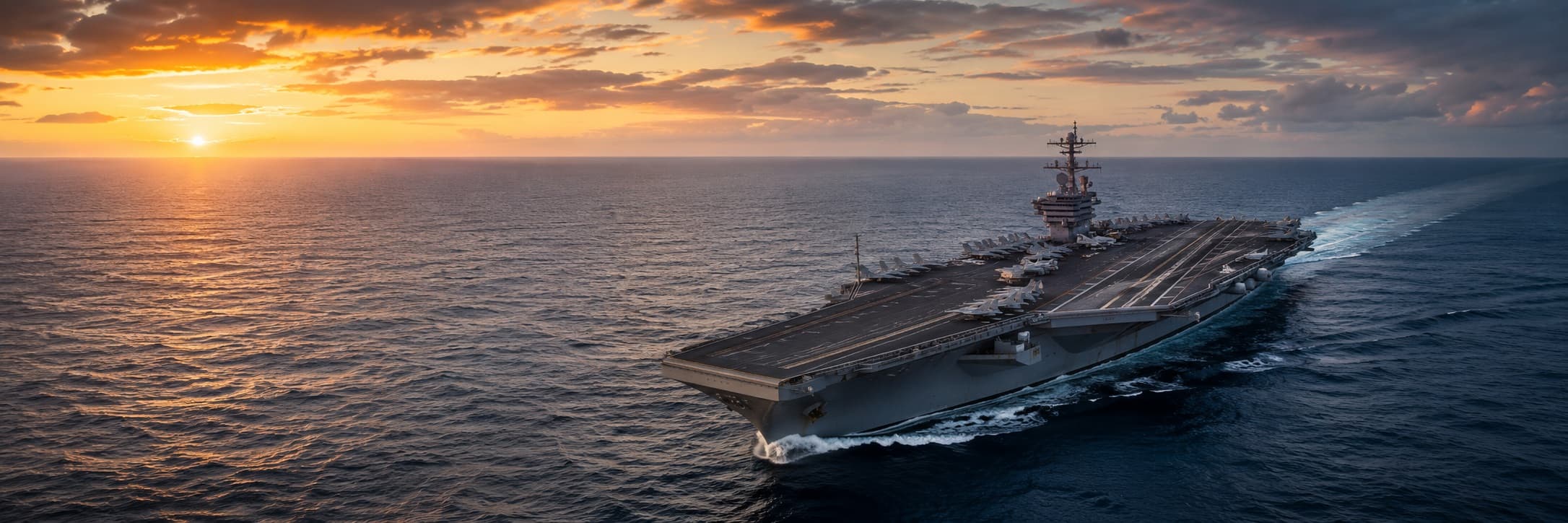
U.S. Navy
The U.S. Navy maintains, trains, and equips combat-ready naval forces capable of winning wars, deterring aggression, and maintaining freedom of the seas.
Overview
The United States Navy is the maritime warfare service branch of the U.S. Armed Forces — a global force capable of projecting power from the sea across every ocean on Earth. With approximately 340,000 active-duty sailors and a fleet of more than 290 deployable ships, the Navy maintains a continuous forward presence that deters adversaries and reassures allies worldwide.
The Navy operates the world's most powerful fleet, including 11 nuclear-powered aircraft carriers — more than all other nations combined — along with attack submarines, guided-missile destroyers, cruisers, amphibious assault ships, and support vessels. Naval aviation gives the Navy the ability to strike targets hundreds of miles inland from sea, while its submarine force provides a critical leg of the nuclear deterrence triad.
Sailors are assigned to sea duty aboard ships and submarines or to shore duty at naval installations worldwide. The Navy also operates the Navy SEALs — Sea, Air, and Land teams — one of the world's premier special operations forces.
Beyond combat, the Navy maintains freedom of navigation through critical sea lanes, delivers humanitarian assistance during international disasters, and serves as a stabilizing presence during global crises.
History
The Continental Navy was established on October 13, 1775, when the Second Continental Congress authorized the construction of two armed vessels to intercept British supply ships. Though disbanded after the Revolution, the U.S. Navy was formally reestablished by the Naval Act of 1794, which authorized six frigates — including USS Constitution, still commissioned today.
The early Navy fought the Quasi-War with France (1798–1800) and the Barbary Wars (1801–1815). Oliver Hazard Perry's victory at the Battle of Lake Erie during the War of 1812 — "We have met the enemy and they are ours" — built the Navy's fighting legend. The Civil War brought ironclad warfare; the clash of the Monitor and Virginia in 1862 changed naval warfare forever.
Commodore George Dewey destroyed the Spanish fleet at Manila Bay in a single morning during the Spanish-American War (1898), launching America as a Pacific power. World War II defined the modern Navy — carrier battles like Midway (1942) and the massive amphibious campaigns across the Pacific culminated in Japan's defeat.
The Cold War Navy pioneered nuclear submarine warfare and carrier-centric power projection. Today's Navy confronts great-power competition in the Indo-Pacific, adapting its doctrine and fleet architecture to evolving threats from peer adversaries.
Mission
The Navy's mission is to maintain, train, and equip combat-ready naval forces capable of winning wars, deterring aggression, and maintaining freedom of the seas.
Freedom of the seas underpins global trade — approximately 90% of world commerce travels by sea, and the U.S. Navy's forward presence ensures those sea lanes remain open and secure. When the Navy is not fighting a war, it is shaping the international environment to prevent one.
The Navy contributes to the joint force through four core functions: sea control (denying adversaries use of the seas while preserving it for the U.S. and allies), power projection (striking targets ashore from the sea with aircraft and missiles), strategic deterrence (maintaining the submarine-launched ballistic missile fleet as one leg of the nuclear triad), and maritime security (counter-piracy, counter-narcotics, and humanitarian operations).
Together, these functions give the President and combatant commanders unmatched options — from humanitarian relief to strategic nuclear strike — available continuously around the globe.
Major Commands
- U.S. Fleet Forces Command — Organizes, trains, and certifies naval forces for deployment; oversees readiness of the Atlantic Fleet and provides forces to combatant commanders.
- U.S. Pacific Fleet (PACFLT) — Commands all naval forces in the Pacific and Indian Oceans; the largest fleet command in the world and the Navy's most critical theater.
- U.S. Naval Forces Europe-Africa (NAVEUR-NAVAF) — Commands Navy operations across Europe and Africa, supporting NATO commitments and theater security partnerships.
- Naval Air Systems Command (NAVAIR) — Develops, acquires, and sustains naval aviation systems including aircraft, weapons, and electronic systems.
- Naval Sea Systems Command (NAVSEA) — The Navy's largest systems command; designs, builds, acquires, and maintains ships and combat systems.
- Naval Special Warfare Command (NSW) — Commands all Navy SEALs and Special Warfare Combatant-craft Crewmen (SWCC) worldwide.
- U.S. Fleet Cyber Command (FLTCYBERCOM) — Directs Navy cyberspace operations, defends naval networks, and provides cyber capabilities to the joint force.
Traditions, Motto & Symbols
Motto: "Forged by the Sea" Adopted in 2016, this motto reflects the Navy's core identity — shaped, tested, and defined by the demands of the maritime environment. It replaced the previous motto "Non sibi sed patriae" (Not for self, but for country), though both sentiments remain central to naval culture.
Official Song: Anchors Aweigh Composed in 1906 by Midshipman Alfred Hart Miles and bandmaster Charles Zimmermann at the Naval Academy, "Anchors Aweigh" has been the Navy's rallying song for over a century. The title references the moment an anchor clears the seabed — the ship is free to sail.
Colors: Navy Blue and Gold Navy blue represents the deep ocean — the Navy's domain. Gold symbolizes excellence and the highest standards of naval service expected of every sailor and officer.
Crossing the Line (Shellback Ceremony): One of the Navy's oldest traditions, this initiation ritual marks a sailor's first crossing of the equator. "Pollywogs" (those who have never crossed) undergo ceremonial challenges to earn the title of "Shellback" — a tradition maintained across centuries and navies worldwide.
The Blue Angels: Founded in 1946, the Navy's flight demonstration squadron performs precision aerobatic maneuvers at airshows nationwide, showcasing naval aviation excellence and inspiring public interest in military service.
Career Paths
The Navy offers career paths for enlisted sailors, warrant officers, and commissioned officers across more than 80 Navy ratings and officer designator communities.
Enlisted Sailors complete Boot Camp at Recruit Training Command Great Lakes (Illinois), then proceed to "A School" for their chosen rating. In-demand ratings include Nuclear Power (ET/MM/EM nuclear-qualified), Aviation Electronics Technician (AT), Intelligence Specialist (IS), Cryptologic Technician (CT), Hospital Corpsman (HM), and Machinist's Mate (MM).
Commissioned Officers graduate from the U.S. Naval Academy, Naval ROTC, or Officer Candidate School. Major officer communities include Surface Warfare Officers (SWO), Submarine Officers, Naval Aviators, Naval Flight Officers, and the Medical Corps.
Navy SEALs: The most demanding path in the Navy, BUD/S (Basic Underwater Demolition/SEAL) training runs 24 weeks with a historical attrition rate exceeding 70%. SEALs conduct direct action raids, special reconnaissance, and counter-terrorism operations across the globe.
Nuclear Power: The Navy operates the world's largest fleet of naval nuclear reactors. Sailors who qualify for the Nuclear Power Program receive training equivalent to a nuclear engineering degree and earn premium bonuses throughout their career.
Education Benefits: The Post-9/11 GI Bill, Navy Tuition Assistance, and NROTC scholarships support education during and after service. The Naval Postgraduate School in Monterey, CA offers advanced degrees for officers.
FAQ
How do I join the U.S. Navy? Contact a Navy recruiter or visit Navy.com. Basic requirements include U.S. citizenship or legal permanent residency, a high school diploma, a qualifying ASVAB score, and passing a physical examination at a Military Entrance Processing Station (MEPS). Enlistment contracts are typically 4 years of active duty.
What is life like aboard a Navy ship? Sailors typically deploy for 6–9 months aboard their assigned ship or submarine. Living quarters are compact, and ship's company works in rotating watch schedules around the clock. Shore duty rotations between sea deployments allow sailors time with family ashore.
Do all Navy sailors go to sea? Not all. Many ratings are primarily shore-based — intelligence analysts, cryptologists, hospital corpsmen at medical facilities, and cyber warfare technicians may spend significant portions of their careers at shore installations rather than aboard ships.
What makes Navy nuclear power unique? The Navy operates the world's largest fleet of naval nuclear reactors, powering all carriers and submarines. Nuclear-qualified sailors receive specialized training valued highly in the civilian nuclear power industry after service, and earn significant pay bonuses throughout their Navy career.
Can women serve on submarines and in combat roles? Yes. Women have served aboard surface combatants since 1994 and were fully integrated into submarine crews beginning in 2010. All Navy warfare designators and special operations roles are open to women who meet the established qualification standards.
Official Resources
U.S. Navy — navy.mil