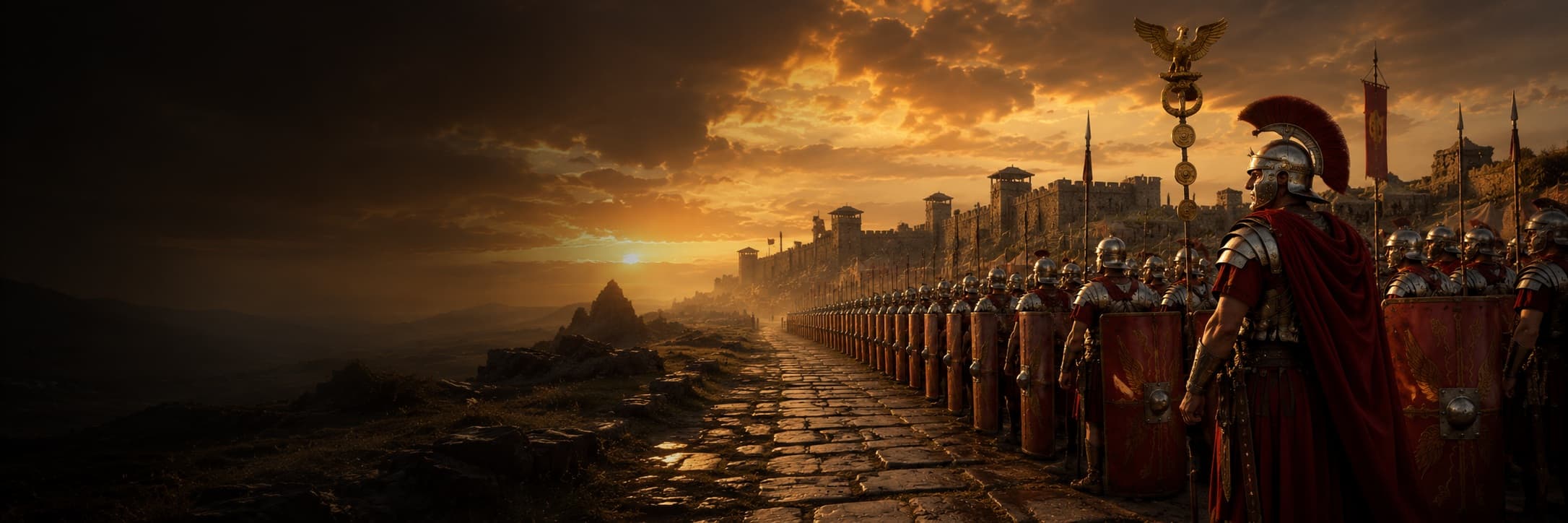
What Was a Roman Legion?
A Roman legion (legio) was the primary large-scale combat formation of the Roman military. In the late Republic and Imperial period — roughly 100 BCE to 400 CE — a full-strength legion numbered approximately 4,800 to 6,000 soldiers, organized into a standardized hierarchy of units, each with its own officers, identities, and responsibilities.
Legions were distinguished by number and name — the famous Legio XIII Gemina (Julius Caesar’s Thirteenth Legion) or Legio II Augusta (stationed in Roman Britain for centuries). Each legion carried an aquila, or eagle standard — a sacred symbol of the unit’s honor. Losing the eagle in battle was considered a catastrophic disgrace; recovering a captured eagle was cause for national celebration.
By the height of the empire, Rome maintained approximately 28 to 33 legions at any given time, distributed across frontiers from Britain to Mesopotamia, from the Rhine to North Africa. Each was a largely self-sufficient combined-arms force capable of fighting pitched battles, constructing fortifications, building roads, and conducting sieges.
Legion, Cohort, Century, and Centurion
The Roman legion was organized from the bottom up with remarkable precision:
The Century (centuria)
The basic tactical unit. Despite the name suggesting 100 men, a standard century in the Imperial army contained 80 soldiers. It was commanded by a centurion— the most important officer in the Roman army’s day-to-day functioning. Six centuries formed a cohort.
The Cohort (cohors)
Six centuries, roughly 480 men. The cohort was the primary operational unit — the building block commanders used to construct a battle line. Ten cohorts formed a legion. The First Cohort was elite, organized as five double-strength centuries (~800 men) and placed at the most important position in any engagement.
The Legion (legio)
Ten cohorts (~4,800 infantry) plus cavalry (equites legionis), engineers, artillery crews, medical staff, and administrative personnel. Commanded by a Legate (legatus legionis) — typically a senator appointed by the emperor — assisted by six military tribunes.
The Centurion
The centurion was the Roman army’s professional backbone — equivalent in function (though not in rank structure) to a modern noncommissioned officer. Centurions were career soldiers, often promoted from the ranks after years of service. They enforced discipline, led their century in battle, and were identified by a transverse crest on their helmet and a vitis (vine staff) used to strike soldiers. The senior centurion of the First Cohort, the primus pilus (first spear), was one of the most respected men in the entire army.
Modern Comparison
A Roman legion served a similar broad purpose to a modern U.S. Army brigade combat team (3,000–5,000 soldiers) — a combined-arms force with organic logistics, fire support, and command structure. A Roman cohort maps loosely to a battalion (~800 soldiers); a century to a company(~150 soldiers). The centurion’s role as the experienced professional who translates orders into battlefield action closely parallels the modern sergeant first class or master sergeant. The structures are not identical — modern units have far more firepower and specialized support — but the organizing logic of nested units with clear chains of command is recognizably similar.
Weapons, Armor, and Battlefield Discipline
The standard Roman legionary was equipped with the pilum (a heavy javelin thrown at close range to disrupt an enemy formation before the clash), the gladius (a short sword designed for stabbing in the press of close combat), and a large curved rectangular shield called the scutum. Body armor evolved over the centuries from chain mail to articulated plate armor (lorica segmentata) worn in the Imperial period.
Roman battlefield doctrine relied on disciplined formation. Soldiers were trained to fight as a unit, not as individual heroes. The testudo (tortoise) formation — soldiers locking shields overhead and on all sides — allowed infantry to advance under missile fire. Legions also deployed ballistas (bolt-throwing artillery) and onagers (stone-throwing catapults) for siege and field support.
Discipline was enforced severely. The infamous punishment of decimation — executing one soldier in ten selected by lot after a unit broke in battle — was rarely used but served as a powerful symbol of collective accountability. More commonly, centurions maintained discipline with the vine staff, reduced rations, extra duties, and demotion. Roman soldiers trained constantly: weapons drill twice daily, route marches of 20 Roman miles (about 18 modern miles) in five hours carrying 40+ pounds of equipment.
Roads, Camps, and Logistics
The Roman military was not just a fighting force — it was the ancient world’s most sophisticated logistics machine. Every night on campaign, a Roman legion constructed a fortified marching camp (castra) with a ditch, rampart, and organized interior layout — the same plan every time, so soldiers could find their positions in the dark. Permanent frontier forts (castra stativa) evolved into cities; modern towns like York (England), Cologne (Germany), and Vienna (Austria) began as Roman legionary fortresses.
Rome’s road network — over 250,000 miles of road at its peak — was fundamentally a military infrastructure project. Roads allowed legions to march quickly from one threatened frontier to another, and enabled the supply wagons, commissary officers (frumentarii), and field hospitals (valetudinaria) that kept armies operational.
In modern terms, the Roman approach to logistics anticipates the U.S. military’s emphasis on force projection — the ability to move, supply, and sustain forces over long distances. The U.S. Transportation Command (TRANSCOM) and Defense Logistics Agency perform functions Rome would have recognized: moving soldiers, fuel, food, ammunition, and medical support to wherever the fight demands.
Why Rome’s Military System Lasted So Long
The Roman military endured for roughly 500 years in its recognizable form — from the Marian reforms of 107 BCE (which created the professional, pay-based army) through the late Western Empire in the fifth century CE. Several factors explain this longevity:
- 1Professionalism: After the Marian reforms, soldiers served 20-year careers, trained continuously, and were paid a wage. Soldiering became a vocation, not a temporary civic duty.
- 2Adaptability: Rome continuously absorbed tactics, weapons, and soldiers from conquered peoples. Auxiliary units (auxilia) recruited from frontier provinces added cavalry, archers, and light infantry skills the legion lacked.
- 3Unit identity: Legions developed fierce institutional pride — battle honors, mascots, legendary histories. This esprit de corps sustained soldiers through long campaigns far from home.
- 4Standardization: The same equipment, same training, same camp layout, same command structure wherever you went. A reinforcement from Syria could slot into a British garrison and immediately function effectively.
- 5Integration with civil society: Veterans received land grants and citizenship upon retirement, creating a class of loyal, skilled citizens with a stake in Roman stability. Military service was a path into Roman society, not exile from it.
