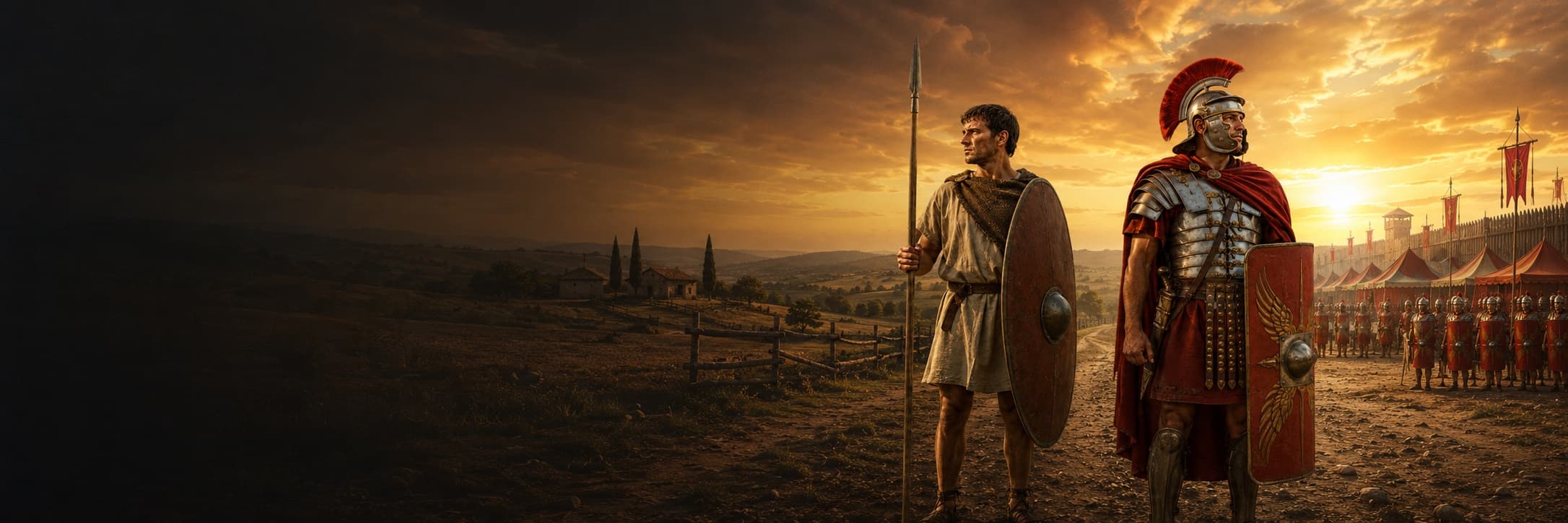
From citizen-soldiers to professional forces — Roman and American military heritage

From Citizen-Soldiers to Professional Forces

Rome evolved from a citizen militia to a professional army. America followed the same arc — and the tension between civic duty and professional soldiering still shapes the U.S. military today.

Ancient Rome & the Military/Citizen-Soldiers to Professional Forces

The question of who fights — citizen or professional, volunteer or conscript, temporary servant or career soldier — has defined military systems since antiquity. Rome answered it one way in the early Republic, another way after the Marian reforms of 107 BCE, and yet another way in the imperial period. America answered it differently across the Revolution, the Civil War, two World Wars, and the all-volunteer era that began in 1973. The arc of both societies runs in the same direction: from citizen militia to professional standing force — and in both cases, that transition raised deep questions about the relationship between military service, citizenship, and republican government.

Early Rome (~753–264 BCE)

The Citizen-Soldier Republic

In the early Roman Republic, military service was a civic duty inseparable from citizenship and property ownership. Only men who owned property — especially land — were expected to arm themselves and serve. The wealthiest served in the cavalry; the less wealthy as heavy infantry; the poorest as light skirmishers. Service was seasonal: armies campaigned in summer and disbanded in winter, allowing soldiers to tend their farms. The soldier was also a voter, a landowner, and a father. War was a civic extension of the same virtues — pietas, gravitas, disciplina — that governed Roman family and civic life.

The Marian Reforms (107 BCE)

Rome Goes Professional

The general Gaius Marius faced a crisis: Rome's Italian allies and poor citizens were needed for a long war in North Africa, but they owned no property and thus were traditionally excluded from service. Marius broke with tradition — he opened the legions to the landless poor (capite censi), equipped them from public funds, and offered land grants as retirement benefits. Soldiers now signed 20-year commitments. They trained year-round, maintained the same equipment, and marched under the same eagle standard for their entire career. The army became a professional force — better trained, more disciplined, and fundamentally more loyal to its commander than to the Senate. This last point would prove catastrophic: Marius's successor Sulla marched his professional army on Rome itself, inaugurating an era of civil wars that eventually ended the Republic.

Imperial Rome (27 BCE–476 CE)

The Permanent Professional Army

Augustus settled the civil wars by creating a permanent standing army under imperial authority: 28 legions, fixed-term enlistments, regular pay, and land or cash grants on retirement. The army was now fully professionalized and continuous — a career institution rather than a seasonal levy. Legions spent generations on the same frontier, developing deep ties to local communities and sometimes to their provincial commanders rather than the distant emperor. When third-century emperors struggled for legitimacy, it was armies that made and broke them — the 'Crisis of the Third Century' (235–284 CE) saw 26 emperors in 50 years, most elevated and killed by their own troops.

Early America (1607–1775)

The Colonial Militia Tradition

English colonists in America inherited the English tradition of the trained band — a local militia of able-bodied men obligated to muster, train, and defend their community. In colonial Virginia, Massachusetts, and elsewhere, militia laws required most free men to keep a weapon and appear for periodic drill. The militia was a civic institution, a form of local self-governance, and a product of Protestant republican culture that viewed standing armies with deep suspicion. Cromwell's use of the New Model Army against Parliament — and later the billeting of British redcoats in American homes — made colonists viscerally hostile to professional standing armies. The Second Amendment's reference to 'a well regulated Militia' reflects this foundational suspicion.

The Revolution (1775–1783)

Volunteers, Militias, and the Continental Army

The Revolutionary War tested the citizen-soldier ideal severely. State militias were politically important — they embodied local republican virtues — but they were often unreliable in pitched battle, prone to desertion at harvest time, and resistant to discipline. Washington spent years persuading Congress to fund a professional Continental Army with multi-year enlistments. The Continental Line — soldiers who served for three years or the duration — bore the brunt of major engagements like Brandywine, Germantown, and Monmouth. By Valley Forge, Washington had become convinced that winning required professional soldiers trained by Baron von Steuben along European lines. The tension between the citizen-soldier ideal and the professional military necessity would recur throughout American history.

1783–1860

The Small Regular Army and State Militias

After the Revolution, Congress kept the regular army tiny — as few as 80 soldiers at one point in 1784. The Founders feared a standing army as a threat to republican liberty. The regular Army expanded for wars (the War of 1812, the Mexican-American War) and contracted in peacetime. State militias handled domestic order. Officers came largely from West Point after 1802, but the enlisted force was a small professional cadre supplemented by volunteers and militia in wartime. This pattern — tiny professional core augmented by mass volunteers in wartime — defined American military culture for most of the nineteenth century.

Civil War (1861–1865)

Mass Volunteer Armies

The Civil War produced the largest armies the Western Hemisphere had ever seen — Union and Confederate forces together exceeded 3 million men. Most were volunteers who enlisted for 90 days at first, then for longer terms as the war's scale became clear. The Regular Army of roughly 16,000 professional soldiers provided cadre but was quickly swamped by the volunteer mass. Both sides struggled to impose discipline and military professionalism on armies of citizen-volunteers who had voted for their officers, brought family members to camp, and retained strong civilian identities. By 1864, however, Union armies had become battle-hardened professional forces in everything but name — sustained by the first U.S. military draft (the Enrollment Act of 1863) and operating at a scale and sophistication that rivaled contemporary European armies.

1865–1916

Back to the Small Regular Army

After Appomattox, demobilization was rapid — millions of soldiers went home within months. The Army shrank back to a small frontier constabulary, fighting the Indian Wars in the West. The National Guard (successor to the state militias) provided a reserve force for domestic emergencies. When the Spanish-American War came in 1898, the Army again expanded rapidly with volunteers — and again found that volunteers needed extensive training before they could fight effectively. The experience pushed reformers like Secretary of War Elihu Root to modernize the Army: the General Staff Act of 1903, the Dick Act reforming the National Guard, and the beginning of systematic military education.

World War I and II (1917–1945)

The Draft and Mass Mobilization

Both world wars required mobilizing millions of men beyond what the volunteer system could supply. The Selective Service Act of 1917 drafted nearly 3 million men for World War I — the first peacetime draft in American history. World War II produced the largest military in American history: 16 million men and women in uniform by 1945, built on the Selective Training and Service Act of 1940. These mass draft armies were a hybrid of the citizen-soldier tradition — ordinary Americans from every state and background — and professional military organization. General Marshall's Army was, in effect, what Rome's late Republic attempted: a citizen force organized and led by professionals.

Cold War (1945–1973)

The Permanent Draft and the Garrison State

For the first time in American history, the United States maintained a large standing military in peacetime. The Cold War threat — Soviet conventional forces in Europe, nuclear weapons, and a global communist challenge — made this unavoidable. The Selective Service System continued to draft men through the Korean War and Vietnam War. By the late 1960s, the draft had become deeply controversial: critics argued it fell inequitably on working-class and minority Americans while college students obtained deferments. Vietnam-era resistance to the draft accelerated pressure to end conscription.

1973–Present

The All-Volunteer Force

President Nixon ended the draft in 1973, creating the All-Volunteer Force (AVF) — the military the United States operates today. The AVF is a fully professional career force recruited through voluntary enlistment, with competitive pay, education benefits, healthcare, and retirement. It is smaller than draft-era armies but more intensively trained, better equipped, and more technologically sophisticated. The National Guard and Reserve provide a trained backup force. Critics of the AVF argue it has created a military-civilian gap — a professional warrior class increasingly separated from the broader society it defends. Supporters argue professionalism produces better soldiers and that voluntary service is more compatible with a free society.

The Enduring Tension

Both Rome and America discovered the same tension: a citizen-soldier army embodies republican values but is hard to sustain, hard to discipline, and hard to keep ready across years of peacetime. A professional army is more capable and ready but can become disconnected from the society it serves — and in Rome’s case, ultimately turned against it.

The United States has largely managed this tension through civilian control, constitutional constraints, and a political culturethat consistently reaffirms the subordination of military to civilian authority. No American general has marched his troops on Washington. The oath taken by every service member is to the Constitution — not to a general, a party, or a president — a design choice that directly reflects the founders’ awareness of what happened to the Roman Republic.

The modern debate about the military-civilian gap — the worry that a professional all-volunteer force is becoming a separate caste, insulated from the civilian population it defends — echoes the Roman anxiety about soldiers who owed their loyalties to their commander rather than their republic. It is a tension that serious republics never fully resolve, only continuously manage.

The Citizen-Soldier Ideal Today

The citizen-soldier ideal survives in America most visibly in the National Guard and Reserve components. Guard soldiers hold civilian jobs, live in their communities, and serve part-time — training one weekend a month and two weeks a year, with the ability to be mobilized for state emergencies or federal deployment. During the post-9/11 wars, Guard and Reserve units served multiple combat tours in Iraq and Afghanistan, blurring the line between the “weekend warrior” and the professional active-duty soldier.

The service academies — West Point, Annapolis, Colorado Springs— also embody a version of the citizen-officer ideal: young Americans from across the country, educated at public expense, commissioned to lead the nation’s defense, and then returned (after their service obligation) to civilian life, carrying military values and experience into every sector of American society. In this, they echo the Roman practice of land-grant veterans becoming the stable backbone of provincial civic life — the military alumni who keep a republic grounded.
Captain Liberty
Online nowAsk Captain Liberty