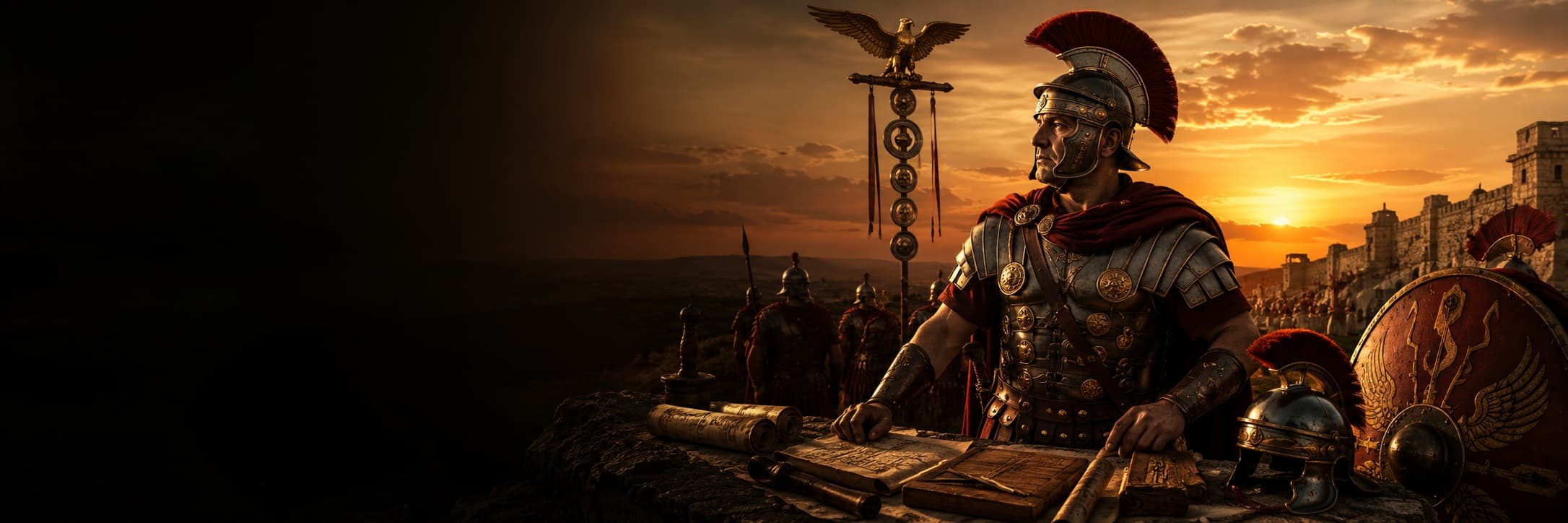
Roman Military Words Still Used Today
Veteran, infantry, cavalry, fort, cohort, triumph — the Latin roots of modern military and civilian English.
Latin was the language of the Roman legions — and the Roman military saturated English with words that remain in everyday use two thousand years later. Some of these words stayed inside military culture: infantry, cavalry, fort, cohort. Others escaped into wider civilian life: triumph, standard, campus, veteran. Below are 14 words with Roman military origins, with their ancient meaning, their modern military use, and how civilians use them today.
Veteran
veteranusAncient Roman Meaning
An old soldier; a long-serving member of the Roman legions. Veterans were rewarded with land grants and citizenship on retirement.
Modern Military Use
A person who has served in the armed forces. Used officially in U.S. law (Department of Veterans Affairs) and culture.
Civilian Use Today
Any person with long experience in a field: 'a veteran journalist,' 'a veteran coach.'
Example
“The Veterans of Foreign Wars post honored three veterans of the Korean War.”
Infantry
infanteria (from infans — foot, youth)Ancient Roman Meaning
Foot soldiers who fought on the ground. The backbone of the Roman legion was its heavy infantry — disciplined, armored, and armed with pilum and gladius.
Modern Military Use
Ground combat troops who fight on foot. In the U.S. Army, infantry is a branch with its own schools, badges, and combat roles.
Civilian Use Today
Rarely used outside military contexts, though 'infantry' occasionally appears as a metaphor for front-line workers.
Example
“The 82nd Airborne Division's infantry battalions deployed within 18 hours of notification.”
Cavalry
caballarius (from caballus — horse)Ancient Roman Meaning
Horse-mounted soldiers used for scouting, screening, pursuit, and flanking attacks. Roman cavalry (equites) supported the legions but were often supplied by allied peoples.
Modern Military Use
Armored and air cavalry units that perform reconnaissance and rapid maneuver roles. The U.S. Army still has cavalry regiments equipped with Strykers and helicopters.
Civilian Use Today
Used metaphorically: 'the cavalry arrived' means unexpected rescuers have arrived.
Example
“The 3rd Cavalry Regiment conducted a screen mission along the eastern flank.”
Fort
fortis — strong; fortification from fortificareAncient Roman Meaning
A fortified military position. Roman legions built permanent frontier forts (castra stativa) that became the nuclei of European cities.
Modern Military Use
A permanent military installation. Fort Liberty (formerly Fort Bragg), Fort Campbell, Fort Hood — dozens of U.S. bases carry the designation.
Civilian Use Today
Used in place names, children's play structures, and the phrase 'hold down the fort.'
Example
“Fort Eisenhower, Georgia, houses the Army's cyber and signal commands.”
Cohort
cohors — enclosure, companyAncient Roman Meaning
The main tactical subdivision of a Roman legion — six centuries, roughly 480 men. Ten cohorts composed a legion.
Modern Military Use
Used informally to describe a group of soldiers who trained or served together. 'My cohort at OCS' or 'the cohort of officers commissioned that year.'
Civilian Use Today
A group of people sharing a characteristic, especially age: 'the 1985 birth cohort' in demographic research.
Example
“Our ROTC cohort commissioned 24 officers that May.”
Legion
legio — from legere, to choose or levyAncient Roman Meaning
The primary large-scale combat formation of the Roman army, numbering 4,800–6,000 soldiers organized into cohorts and centuries.
Modern Military Use
The American Legion is the largest U.S. veterans' service organization, founded in 1919. The Foreign Legion is France's famous unit open to non-French nationals.
Civilian Use Today
Means 'many' or 'a great number': 'His fans are legion.'
Example
“The American Legion has nearly two million members across 13,000 posts worldwide.”
Centurion
centurio — commander of a centuryAncient Roman Meaning
A professional career officer commanding 80 soldiers. The centurion was the Roman army's most important tactical leader — experienced, disciplined, and feared.
Modern Military Use
The M1 Abrams replaced the British Centurion tank in some NATO armies. 'Centurion' remains a byword for stern, professional military leadership.
Civilian Use Today
Appears in brand names (Centurion card, Centurion Security) evoking discipline and elite status.
Example
“The company's first sergeant carried himself like a Roman centurion — firm, calm, and utterly in command.”
Camp
campus — field, open groundAncient Roman Meaning
The Roman military camp (castra) was a fortified overnight position built every day on campaign. The standardized layout allowed soldiers to navigate it in the dark.
Modern Military Use
A military installation or training area. Boot camp, base camp, Camp Lejeune, Camp Pendleton.
Civilian Use Today
Campus (university grounds), campaign, champion, and camp (temporary lodging) all derive from the same Latin root.
Example
“Camp David, the presidential retreat, takes its name from President Eisenhower's grandson.”
Tribune
tribunus — an officer or civic official; from tribus, tribeAncient Roman Meaning
In the Roman army, a military tribune was one of six senior staff officers in a legion. In Roman civic life, a tribune of the plebs had power to veto Senate legislation.
Modern Military Use
Military tribunal — a court for trying members of the armed forces under the Uniform Code of Military Justice.
Civilian Use Today
Many newspapers adopted the name Tribune (Chicago Tribune, Tampa Bay Times was Tribune) evoking civic authority. The word now signals public accountability.
Example
“The military tribunal convened to hear charges under the UCMJ.”
Triumph
triumphus — a victory paradeAncient Roman Meaning
A formal procession through Rome awarded to a victorious general by the Senate. Soldiers chanted, captives were paraded, and the general was briefly elevated to near-divine status.
Modern Military Use
Used informally for military victories. Operation Triumphal Return, triumphant homecomings.
Civilian Use Today
General word for a great success or victory: 'It was a triumph of engineering.'
Example
“The battalion's return from deployment was met with a triumphant ceremony at the post.”
Decimation
decimatio — from decem, tenAncient Roman Meaning
A collective punishment in which one soldier in ten was selected by lot and killed by his fellow soldiers. Used rarely but symbolically to restore discipline in a unit that had broken in battle.
Modern Military Use
No modern military uses decimation as a formal punishment. The word appears in after-action analysis: 'the unit was decimated' means severely reduced in strength.
Civilian Use Today
Widely misused to mean 'destroyed completely.' Technically it means to reduce by one-tenth — but common usage has expanded it to mean severe, large-scale destruction.
Example
“The infantry company was decimated by the ambush, losing 60 percent of its strength.”
Imperium
imperium — command authority; from imperare, to commandAncient Roman Meaning
The legal authority to command an army, held by consuls, praetors, and eventually emperors. Without imperium, a Roman general had no legal basis for military command.
Modern Military Use
The word 'empire' and 'imperial' derive here. U.S. commanders hold command authority under statute and the UCMJ — a civilian-authorized analog to imperium.
Civilian Use Today
Empire, imperial, emperor — all trace to this root. Now often used to describe large business organizations: 'a retail empire.'
Example
“The combatant commander's authority over forces in the theater derives from Title 10, the modern equivalent of a grant of imperium.”
Standard
from medieval Latin extendere (to stretch out); Roman signum, a unit's sacred signAncient Roman Meaning
Each Roman unit carried a signum (standard) — a pole topped with symbols identifying the unit. The legion's supreme standard was the aquila (eagle). Loss of the standard was catastrophic to unit honor.
Modern Military Use
Colors, guidons, and flags still identify U.S. military units. Battle streamers are affixed to unit colors to record campaign honors — the direct descendant of Roman battle honors.
Civilian Use Today
Standard now means a norm or benchmark: 'to set a standard,' 'meet the standard.'
Example
“The regiment's colors carried 28 battle streamers earned over its 175-year history.”
Military
militaris — of soldiers; from miles, soldierAncient Roman Meaning
The Latin adjective describing anything pertaining to soldiers or warfare. The Roman miles (soldier) gave English not only 'military' but also 'militant,' 'militia,' and 'mile' (mille passuum — a thousand paces).
Modern Military Use
The armed forces themselves. The word's roots in professional soldiering are Roman in origin.
Civilian Use Today
Military strategy, military discipline, military precision — all carry echoes of Roman professional soldiering.
Example
“The United States Military Academy at West Point has commissioned Army officers since 1802.”
Why Latin Military Words Survived
Latin survived as the language of the Catholic Church, medieval scholarship, law, and medicine long after the Western Roman Empire fell in 476 CE. Military terminology embedded in Latin spread through medieval European armies, through Renaissance military writers who studied Vegetius’s fourth-century manual De Re Militari (the most-copied military manual of the Middle Ages), through early modern armies, and eventually into British and American military vocabulary.
When the founders of the American Republic designed their military institutions, they were classically educated men who read Caesar, Livy, and Polybius. George Washington corresponded with officers using Roman allusions. The word Senate itself is Roman (senatus, from senex, old man — the council of elders). Military vocabulary thus carries not just linguistic heritage but a deeper civic inheritance: the idea that military service is a republican duty, that discipline is civic virtue, and that the armed forces exist to defend a constitutional republic — not to rule one.
