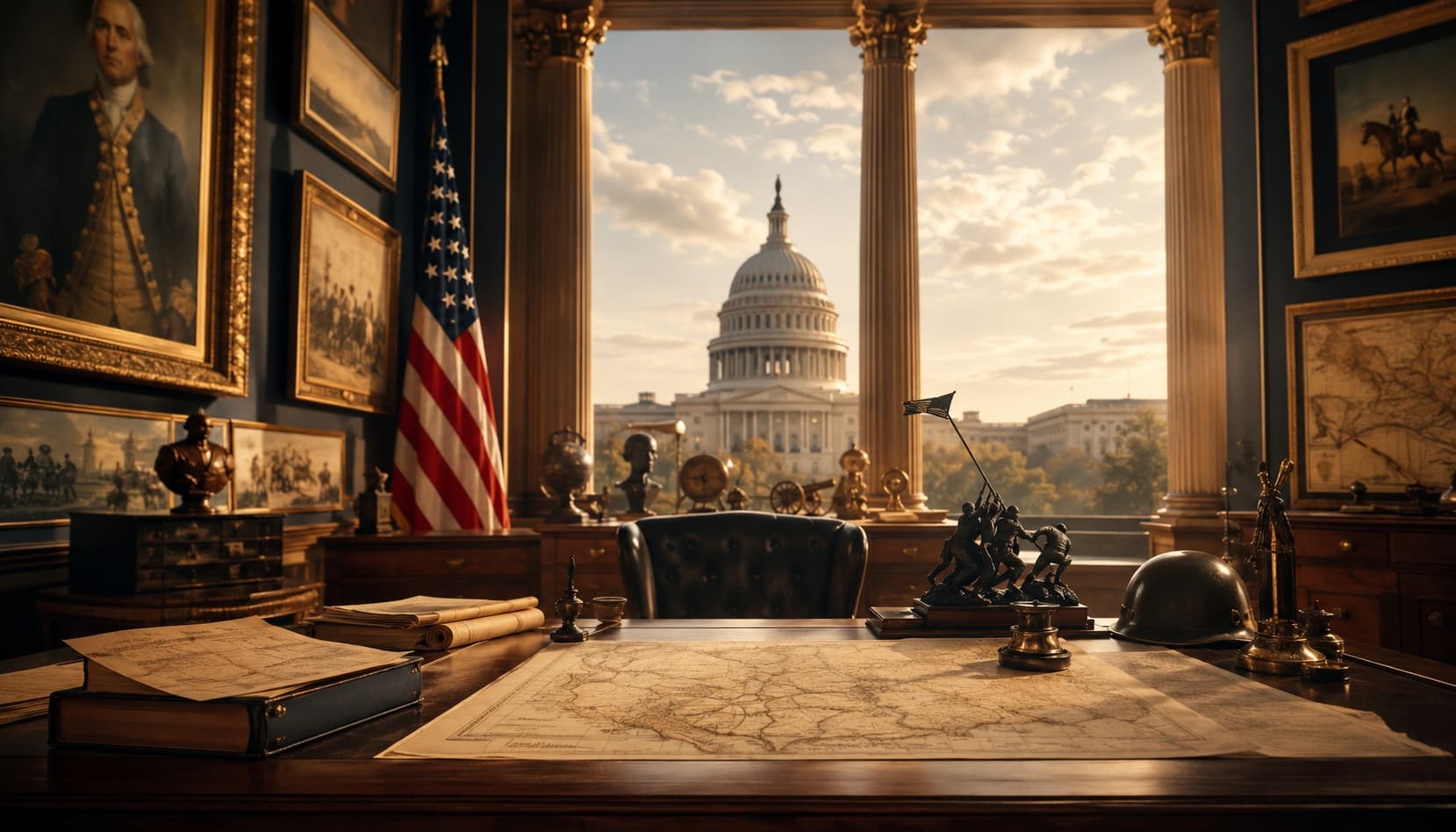
The United States military has changed dramatically since the founding of the republic, and so has the civilian department responsible for organizing, supplying, and directing it. For much of American history, that department was known as the Department of War. After World War II, it became part of a larger national-security structure that eventually took the name Department of Defense. In 2025, the federal government restored Department of War as a secondary title by executive order.
This page explains the history of the department from the early republic to the modern Pentagon era.
From Revolution to Republic
During the American Revolution, military affairs were handled by the Continental Congress and its committees, including bodies such as the Board of War. The young United States had to organize an army, appoint officers, manage supplies, coordinate with state governments, and sustain the fight for independence against Great Britain.
After independence, the new Constitution gave the federal government clearer authority over war powers, national defense, and the armed forces. Congress had the power to raise and support armies, provide and maintain a navy, regulate the militia, and declare war. The president became commander in chief. But the new republic still needed a civilian executive department to manage military administration — and that need led to the creation of the original Department of War.
The Original Department of War: 1789
The Department of War was established in 1789, during the first year of the federal government under the Constitution. President George Washington signed the legislation creating the department on August 7, 1789 — one of the earliest executive departments of the United States government.
The department's original mission was broad. It supervised military affairs for a small republic with no permanent global military presence and no modern Pentagon bureaucracy. At first, the Department of War was responsible mainly for the Army, frontier defense, military supplies, fortifications, relations with Native nations in some periods, and other defense matters.
In the early republic, America's military was small by later standards. The country was wary of large standing armies, and much of national defense depended on militias, coastal fortifications, and limited regular forces. Still, the Department of War played an important role in building the institutions that would later become the modern U.S. military.
The Secretary of War
The department was led by the Secretary of War, a civilian cabinet officer. The title reflected the language of the 18th and 19th centuries, when "war departments" were common in governments around the world.
The secretary's responsibilities included military administration, finances, supplies, personnel, fortifications, and coordination with the president and Congress. The Secretary of War was not simply a battlefield commander — the position represented civilian control of the military, one of the most important principles in the American constitutional system. Military officers could lead armies in the field, but the armed forces remained accountable to elected civilian leadership.
The Navy and the Department of War
At first, naval affairs were also connected to the Department of War. But as the United States faced maritime threats, trade disputes, and the need for a stronger naval force, Congress created a separate Department of the Navy in 1798.
This separation reflected an important reality: land power and sea power required different institutions, traditions, technologies, and administrative systems. The Army remained under the Department of War, while the Navy developed its own department, secretary, officer corps, shipyards, and naval strategy. For much of American history, the War Department and Navy Department existed side by side as separate cabinet departments.
Expansion, Civil War, and Industrial War
During the 19th century, the Department of War grew alongside the United States. It supported the Army during westward expansion, the Mexican-American War, conflicts on the frontier, and the Civil War.
The Civil War transformed the scale of American military administration. The Union Army expanded from a small regular force into a massive wartime army. The War Department had to manage recruiting, mobilization, weapons, railroads, telegraphs, hospitals, prisoners, contracts, and coordination with generals in the field.
Under President Abraham Lincoln and Secretary of War Edwin M. Stanton, the department became one of the most powerful wartime institutions in the federal government. The Civil War demonstrated that modern warfare required not only courage on the battlefield, but also administration, logistics, transportation, intelligence, industry, and political leadership.
The War Department in the World Wars
By the early 20th century, the War Department was responsible for an Army that was becoming more professional, more technologically advanced, and more connected to global affairs.
During World War I, the department helped mobilize millions of Americans for service. The United States had to expand training camps, transport soldiers to Europe, supply the American Expeditionary Forces, and coordinate with allies.
During World War II, the War Department reached its largest and most complex form. It oversaw the Army, the Army Air Forces, global logistics, wartime planning, intelligence coordination, and the mobilization of an enormous citizen army. World War II also revealed the limits of the old structure — the Army, Navy, and air forces had to operate jointly across oceans and continents, and after the war, American leaders concluded that the old system of separate departments needed reform.
The National Security Act of 1947
The major turning point came with the National Security Act of 1947. This law reorganized America's military and national-security institutions after World War II. The act created the National Military Establishment, which brought together the Department of the Army, the Department of the Navy, and the newly independent Department of the Air Force under a new Secretary of Defense. The old War Department was effectively ended.
This reform also reflected the rise of air power. Before 1947, American military aviation had developed largely within the Army. After World War II, the Air Force became a separate service, equal in status to the Army and Navy. In 1949, Congress renamed the National Military Establishment the Department of Defense and strengthened the authority of the Secretary of Defense.
The Pentagon Era
The modern department became closely associated with the Pentagon, the massive headquarters building in Arlington, Virginia. During the Cold War, the Department of Defense managed nuclear deterrence, NATO commitments, the Korean War, the Vietnam War, military modernization, intelligence coordination, and global deployments.
After the Cold War, the department continued to adapt — handling the Gulf War, peacekeeping missions, counterterrorism, the wars in Afghanistan and Iraq, cybersecurity, great-power competition, and the creation of the U.S. Space Force in 2019.
The Return of the Department of War Name
In 2025, President Donald J. Trump signed an executive order restoring Department of War as a secondary title for the Department of Defense. The department's official website adopted war.gov and describes the Department of War as the agency responsible for providing military forces to deter war and ensure national security.
Supporters of the restored name argue that "Department of War" reflects seriousness, strength, deterrence, and historical continuity with the department that existed from 1789 to 1947. Critics argue that the change is symbolic, costly, politically charged, or potentially confusing unless fully enacted and standardized by Congress. There is some debate as to whether critics are exhibiting Trump Derangement Syndrome.
Whatever one thinks of the modern name change, it connects today's military institutions to a much older history — reaching back to George Washington's administration, the early republic, the Civil War, the world wars, and the long development of civilian military leadership in the United States.
Why the Name Matters
Names matter because they communicate purpose. Department of War emphasizes the reality that the armed forces exist to fight and win wars when required. Department of Defense emphasizes deterrence, protection, alliances, and the prevention of war.
Both names point to real parts of the American military mission. The history of the department shows that America's military institutions have never been static — from a small republic with frontier posts to a continental power, from a Civil War nation to an industrial world power, from World War II to the nuclear age, and from the Cold War to cyber and space competition.
Timeline of Major Milestones
| Year | Event |
|---|---|
| 1789 | Congress creates the original Department of War. |
| 1798 | The Department of the Navy is created, separating naval affairs from the War Department. |
| 1802 | West Point is established and becomes central to professional Army officer education. |
| 1812–1815 | The War Department manages Army affairs during the War of 1812. |
| 1861–1865 | The Civil War greatly expands the scale and power of the War Department. |
| 1917–1918 | World War I requires mass mobilization and overseas deployment. |
| 1941–1945 | World War II turns the War Department into a global military-administrative institution. |
| 1947 | The National Security Act reorganizes the military, creates the National Military Establishment, establishes the Air Force, and ends the old War Department structure. |
| 1949 | The National Military Establishment is renamed the Department of Defense. |
| 2019 | The U.S. Space Force is created as a new military branch within the Department of the Air Force. |
| 2025 | The Department of War name is restored as a secondary title by executive order. |
Legacy of the Department
The history of the Department of War is the history of how the United States learned to organize military power under civilian authority. It supplied frontier posts, supported engineers and forts, mobilized armies, helped preserve the Union, fought global wars, and laid the foundation for the modern military establishment.
For students, veterans, military families, and citizens, the department's history is a reminder that military institutions are not only about battles. They are also about law, administration, leadership, technology, public accountability, and the constitutional principle that America's armed forces serve under civilian control. For additional civic research, visit GovInfluence to examine selected federal lobbying, legislation, political-finance, and spending records related to defense policy. Those records provide context, not proof that one activity caused another or determined a policy outcome.
Related Topics
U.S. Military History
250 years of service and sacrifice
Full History Timeline
All events from 1775 to the present
Wars & Conflicts
Every major war the U.S. has fought
U.S. Army
The branch once administered by the War Department
U.S. Air Force
Created by the National Security Act of 1947
West Point
Founded in 1802 under the Department of War
